The minimalist home design movement has produced a curious contradiction: a market for "minimalist" products—minimalist furniture, minimalist décor, minimalist organisational systems—that is, itself, maximal. You can now spend thousands of rupees achieving the look of someone who has very little, which is a specific kind of consumerist irony that the design industry has not paused to appreciate. The ₹45,000 Muji-style shelf that holds three books and a succulent, the ₹12,000 concrete planter that contains one cactus, the ₹8,000 "minimalist" desk lamp whose primary design feature is the absence of features—these products gesture toward simplicity while participating enthusiastically in the consumption-driven economy that genuine minimalism supposedly rejects.
Real minimalist home design—the kind that produces spaces of genuine calm and visual coherence—does not require expensive purchases. It requires a different relationship with objects: a willingness to evaluate every item in your home against the question "does this contribute to my life, or does it merely occupy space?" and the discipline to act on honest answers. The result of this evaluation is typically the removal of 30-50% of a household's possessions, producing spaces that feel larger, calmer, and more functional without spending a single rupee on new purchases. The paradox of minimalist design is that the most impactful interior design intervention is subtraction, not addition—and subtraction is free.
The Principles: What Makes a Space Feel Minimalist

A space that feels minimalist is not necessarily a space that contains very few things. It is a space where everything present serves a clear purpose (functional or aesthetic), where visual noise has been reduced so that the remaining elements can be appreciated individually, and where the proportional relationships between objects, surfaces, and empty space produce a sense of visual order that the brain experiences as calm. The principles that produce this feeling:
Negative Space: The most important "element" of minimalist design is the space between objects. A shelf lined with books from edge to edge is visually dense and cognitively demanding—each book competes with its neighbours for attention. The same shelf with 30% of the books removed, with deliberate gaps between groups, creates visual breathing room that allows the eye to rest and the brain to process the composition without overload. This principle applies to every surface in your home: countertops, tabletops, walls, floors. The more empty surface you can maintain, the more spacious, calm, and intentional the space feels. The practical implication is straightforward: if a surface is covered with objects that are not actively in use, most of those objects should be in storage (drawers, cabinets, closed shelving) rather than on display.
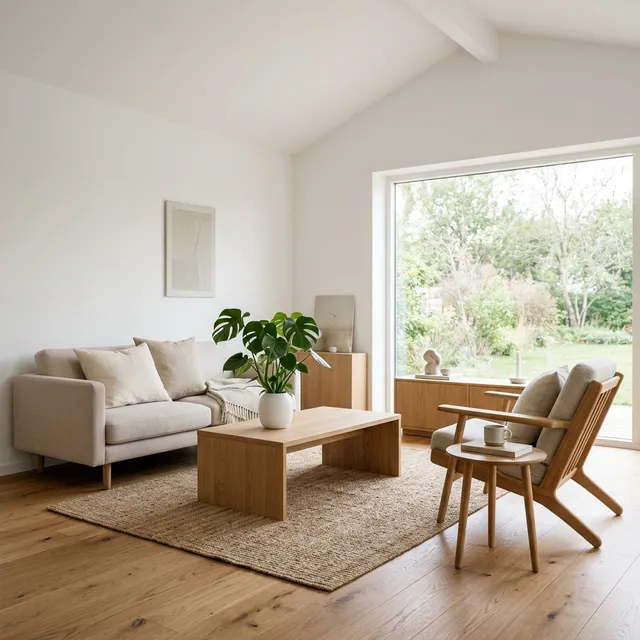
Colour Restraint: Minimalist interiors use restricted colour palettes—typically 2-3 dominant colours plus neutrals. The specific colours matter less than the restriction: a room painted in a single shade of warm white, with wood-toned furniture, green plants, and no competing colours, feels unified and calm. The same room with a red cushion, a blue vase, a yellow lamp, and a patterned rug feels chaotic—not because any individual item is ugly, but because the colour complexity exceeds what the eye can process comfortably at rest. The most effective minimalist colour strategy for Indian homes: warm neutral walls (off-white, warm grey, or light beige), natural wood furniture (teak, sheesham, pine), and green from plants as the single accent colour. This palette accommodates Indian light conditions beautifully and creates a warmth that pure-white minimalism (which can feel clinical in Indian contexts) does not achieve.
Material Honesty: Let materials be themselves. Exposed wood grain (not laminated over or painted), visible stone texture (not covered with tablecloths or coasters), concrete surfaces (not tiled or carpeted), and natural fabrics (cotton, linen, jute—not synthetic velvet or plastic-coated materials) create sensory richness within visual simplicity. The human eye and hand can distinguish between natural materials and synthetic imitations, even subconsciously—natural materials produce a sense of quality and authenticity that synthetic alternatives cannot replicate regardless of how convincing they look in photographs.
Room-by-Room: Practical Minimalist Design for Indian Homes
Living Room: The Indian living room serves multiple functions (entertaining, family gathering, television watching, occasionally sleeping) and must accommodate these functions without becoming cluttered. The minimalist approach: one comfortable sofa (not a sofa plus two armchairs plus a loveseat—if you occasionally need additional seating, use stackable stools or floor cushions that can be stored when not in use), one coffee table or side table (not both), a television mounted on the wall rather than on a stand (the stand creates visual clutter and occupies floor space), and concealed storage (a closed cabinet or built-in shelving with doors) for remote controls, cables, magazines, and the miscellaneous objects that accumulate on surfaces. The floor should be as clear as possible—no cable tangles, no magazine racks, no footrests except when in use.
Kitchen: Indian kitchens are under particular pressure because Indian cooking requires a larger number of utensils, spices, and ingredients than most Western cuisines—a legitimate argument against extreme kitchen minimalism. The practical minimalist kitchen retains all necessary cooking equipment but stores it out of sight: spice boxes in drawers or behind cabinet doors rather than on the counter, cooking pots and pans in under-counter cabinets rather than hanging from racks, and small appliances (mixer-grinder, pressure cooker, rice cooker) stored in cabinets and brought out only during use. The counter surface—the most visually dominant element of any kitchen—should contain only items in daily active use: the stove, a cutting board, perhaps a kettle. Everything else is stored. This single change—clearing the kitchen counter—transforms the visual experience of an Indian kitchen more dramatically than any other intervention.
Bedroom: The minimalist bedroom serves one primary function: sleep. Everything that does not contribute to sleep quality or the morning/evening routine should be relocated. No television (screens in the bedroom disrupt sleep hygiene). No desk (working in the bedroom blurs the psychological boundary between rest and productivity). No exercise equipment (unless you actually use it daily—otherwise it becomes an expensive clothes rack). The bed, two nightstands, a lamp, and a wardrobe (with doors, not an open rack) constitute a complete minimalist bedroom. The wardrobe is the critical element: a well-organised wardrobe with sufficient storage makes the room feel calm; an overflowing wardrobe with doors that won't close makes the room feel stressful regardless of how minimalist the rest of the room appears.
Frequently Asked Questions (FAQs)
How do I start decluttering when I have too much stuff?
Start with a single drawer. Not a room, not a closet—a single drawer. Remove everything, clean the drawer, and put back only items you have used in the past 30 days. Everything else goes into a "decision box": items you are unsure about stay in the box for 60 days; if you haven't retrieved an item in 60 days, donate or discard it. This method is sustainable because it is small enough to complete in 15 minutes (eliminating the overwhelm that causes most decluttering projects to stall), it produces an immediate visible result (one clean, organised drawer), and the psychological reward of that visible result motivates the next drawer, then the next shelf, then the next closet. The process scales naturally from a single drawer to an entire home over weeks or months.
Is minimalist design practical with children?
Yes, but it requires realistic expectations. A minimalist home with children is not a pristine showroom—it is a home where the adults' aesthetic preferences and the children's developmental needs coexist through design. Practical strategies: designate one room or area as the children's play zone where mess is expected and accepted; provide abundant closed storage in the play area (bins, baskets, cabinets) so that toys can be quickly tidied out of sight when not in use; rotate toys (store half the toys and swap them quarterly—children engage more deeply with fewer toys, and the rotation provides novelty without additional purchases); and accept that certain rooms (kitchen, living room) will not maintain their minimalist state during active family hours—the goal is "easy to restore" rather than "permanently pristine."
Where can I buy minimalist furniture affordably in India?
IKEA (available in Bangalore, Hyderabad, Mumbai, and online) is the most affordable source of clean-lined, functional furniture with a minimalist aesthetic. Urban Ladder, Pepperfry, and WoodenStreet offer mid-range options with Indian-appropriate dimensions and wood choices. For the most affordable option: local carpenters can build clean, minimalist furniture (simple wooden beds, floating shelves, built-in storage, basic desks) at 30-50% less than branded furniture, using solid wood rather than particle board—producing pieces that are both cheaper and higher-quality than mass-market alternatives. Provide the carpenter with reference images from Pinterest or design magazines, specify the wood type and finish, and supervise the first piece closely to establish quality expectations.
The Emotional Dimension of Decluttering: The practical challenge of minimalist design is not aesthetic—it is emotional. Objects carry memories, obligations, and identities that make discarding them psychologically difficult even when the objects are functionally useless. The inherited furniture you do not like but feel guilty about donating. The gifts from people you care about that do not match your space or taste. The clothes you no longer wear but keep because they represent a version of yourself you are reluctant to release. Addressing this emotional dimension requires honest self-examination: keeping an object out of guilt does not honour the gift-giver—it clutters your space with the physical residue of an obligation. Keeping clothes you no longer wear does not preserve the identity they represent—it fills your wardrobe with a past self that prevents your present self from dressing with intention. The permission to let go—to donate, to discard, to release—is the emotional foundation on which minimalist design is built.


Comments (0)
Be the first to share your thoughts on this article.