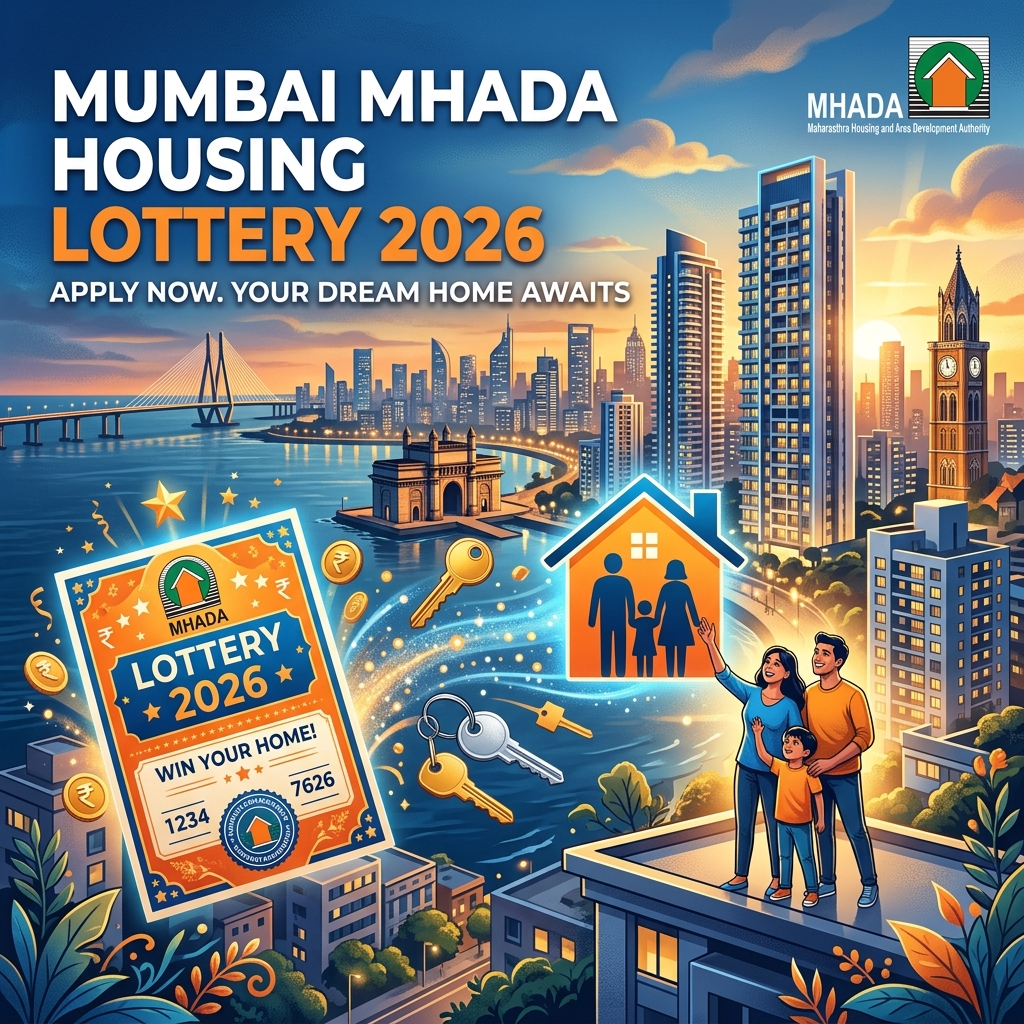
In a city where a parking spot can cost more than a house in most other Indian cities, MHADA just announced 2,640 apartments at prices that would make any Mumbaikar do a double take. The Maharashtra Housing and Area Development Authority's 2026 lottery—the annual exercise in hope, mathematics, and the suspended disbelief required to imagine actually owning a home in Mumbai—has opened applications for affordable housing units spread across Mumbai's metropolitan region at prices starting from ₹16 lakh. Sixteen lakh rupees. In Mumbai. For a house. The numbers seem like a typographical error until you understand the specific, deeply particular institutional mechanism that makes them possible—and the specific, deeply frustrating limitations that prevent this mechanism from solving Mumbai's housing crisis at the scale the city desperately needs.
Mumbai's relationship with affordable housing is, to put it diplomatically, catastrophic. The city faces a housing shortage estimated at 1.2-1.5 million units for lower-income and middle-income families. The average price of a residential apartment in Mumbai—across all categories, including the distant suburban periphery—exceeds ₹1.2 crore. In sought-after locations (Bandra, Andheri, Powai, Thane), prices range from ₹1.5-4 crore for a 2BHK apartment. The median household income in Mumbai is approximately ₹8-12 lakh per year. The arithmetic is devastating: a family earning ₹10 lakh annually would need to save their entire pre-tax income for 12-15 years—with zero expenditure on food, transportation, education, healthcare, or anything else—to afford an average-priced Mumbai apartment. The idea that a middle-class Indian family can "save up" to buy a home in Mumbai through conventional means is, in the current market, a mathematical impossibility disguised as a cultural expectation.
MHADA 2026 Lottery: What's Actually Being Offered

The 2026 MHADA lottery offers 2,640 residential units across four income categories, each with specific eligibility criteria, price ranges, and apartment configurations. Understanding these categories is essential because MHADA's pricing structure is not a single number but a stratified system designed to serve different income levels:
Economically Weaker Section (EWS): These are the smallest and most affordable units—typically one-room apartments (locally called "1RK" or one-room kitchen) ranging from 250-350 square feet of carpet area, priced between ₹16-30 lakh depending on location. Eligibility requires the applicant's annual household income to be below ₹6 lakh. The EWS category represents MHADA's core social mission: providing a permanent, legal, structurally sound home to families who would otherwise live in informal settlements (slums), unauthorized constructions, or multi-family shared rental arrangements in deeply inadequate conditions. The demand-to-supply ratio in this category is staggering—typically exceeding 100:1, meaning that for every available EWS unit, more than 100 eligible families apply.
Lower Income Group (LIG): One-bedroom apartments (1BHK) with 350-500 square feet of carpet area, priced between ₹30-55 lakh. Annual household income eligibility ranges from ₹6-10 lakh. The LIG category targets young working professionals, small business operators, and dual-income families at the lower end of Mumbai's middle class—people who earn enough to be excluded from welfare housing but nowhere near enough to afford market-rate apartments. This category consistently generates the highest application volumes relative to available units.
Middle Income Group (MIG): Two-bedroom apartments (2BHK) with 500-700 square feet, priced between ₹55 lakh to ₹1.2 crore. Annual household income eligibility: ₹10-20 lakh. The MIG category represents a genuine, meaningful discount to market prices—a 2BHK MHADA apartment in Goregaon or Kandivali at ₹80 lakh would cost ₹1.5-2.5 crore at prevailing market rates for comparable new construction in the same locality. The savings are not marginal; they are life-altering. The difference between ₹80 lakh and ₹2 crore is not merely a larger home loan—it is the difference between a mortgage that is manageable on a middle-class income and one that consumes the family's entire financial future.
Higher Income Group (HIG): Larger apartments (2BHK and 3BHK) with 700-1,000+ square feet, priced between ₹1.2-2.5 crore. Annual household income eligibility: above ₹20 lakh. The HIG category offers the smallest discount to market prices (since comparable market-rate apartments in HIG locations may cost ₹3-5 crore) and generates the highest absolute revenue for MHADA, which cross-subsidizes the deeply discounted EWS and LIG units.
How MHADA Pricing Works: The Subsidy Architecture
MHADA's below-market pricing is possible because of three specific structural advantages that conventional private developers cannot replicate:
Land Cost Subsidy: MHADA constructs housing on government-owned land—land that is either directly allocated by the state government or acquired decades ago at historical prices that bear no relationship to current market valuations. Land cost constitutes 40-60% of a private developer's total project cost in Mumbai. By building on government land that is either free or valued at nominal administrative rates, MHADA eliminates the single largest cost component of Mumbai housing, enabling pricing that is structurally unreachable by any private developer operating on commercially acquired land.
No-Profit Construction: MHADA is a statutory authority, not a commercial enterprise. It does not target developer margins (which typically range from 15-30% of total project cost for private builders), does not pay dividends to shareholders, does not fund expensive marketing campaigns, and does not maintain showrooms and sales infrastructure. Its construction costs reflect actual material, labour, and administrative expenses—approximately ₹3,500-5,000 per square foot for construction alone, compared to ₹4,000-6,000 for private developers who build to similar quality standards but layer commercial margins, financing costs, and marketing expenditure on top. The cost difference is not enormous on a per-square-foot basis, but it compounds significantly when combined with the land cost elimination.
Cross-Subsidy Model: Revenue from HIG units (which generate the smallest discount but the highest absolute revenue per unit) and from the sale of surplus FSI (Floor Space Index) and TDR (Transfer of Development Rights) cross-subsidizes the deeply discounted EWS and LIG units. This internal cross-subsidy mechanism allows MHADA to sell EWS units at ₹16 lakh—far below the actual construction cost—by recovering the subsidy from higher-income category sales. The model is economically elegant but politically fragile: it depends on sufficient HIG demand to fund EWS subsidies, and any HIG underperformance directly constrains EWS supply.
The Application Process: Navigating the Lottery
MHADA lottery applications are submitted online through the MHADA website (lottery.mhada.gov.in). The process involves: creating a user account, selecting the applicable income category, uploading identity documents (Aadhaar card, PAN card), income documentation (salary slips, IT returns, income certificate from employer or chartered accountant), address proof (demonstrating Mumbai/MMR residency for the required duration, typically 15+ years for Mumbai and shorter for extended metropolitan region locations), and paying a non-refundable application fee and an earnest money deposit (EMD: typically ₹25,000-2,00,000 depending on category and unit price).
The lottery draw is conducted digitally, with the sequence randomized by computer algorithm in the presence of observers and often live-streamed. Successful applicants receive allotment letters specifying their unit number, building, and payment schedule. The balance payment must typically be completed within 120-180 days of allotment—either through a housing loan from an approved bank (most applicants require financing) or from personal savings. Applicants who fail to complete payment within the stipulated period forfeit their allotment, and the unit is offered to the next applicant on the waiting list.
The practical challenges of the application process are not trivial. Income documentation requirements—particularly for self-employed applicants, informal sector workers, and those with income from multiple sources—can be complex and exclusionary. The 15-year Mumbai residency requirement (for Mumbai-located units) excludes recent migrants who may be among the city's most housing-insecure residents. The EMD payment requirement, while modest relative to the apartment price, represents a significant outlay for EWS-eligible families with limited savings. MHADA has progressively digitized and simplified the process—the shift from physical paper applications (which required in-person submission and generated allegations of queue manipulation) to online applications has improved accessibility, though digital literacy barriers affect some eligible applicants.
The Catch: Location, Quality, and Supply Constraints
MHADA apartments at ₹16-50 lakh exist. They are real. They are legal. They are structurally sound. And they come with significant caveats that explain why Mumbai's housing crisis persists despite MHADA's decades-long construction programme:
Location: The most affordable MHADA units (EWS and LIG categories) are overwhelmingly located in Mumbai's distant suburbs and extended metropolitan region—Virar, Vasai, Nallasopara, Karjat, Panvel, Taloja. These locations are geographically within the Mumbai Metropolitan Region but may involve 2-3 hour one-way commutes to major employment centres in the city's commercial core (BKC, Lower Parel, Nariman Point) or even the suburban employment hubs (Andheri, Goregaon, Malad). For a factory worker in Andheri, a MHADA apartment in Virar at ₹20 lakh is theoretically affordable but practically inaccessible—the daily commute consumes 4-6 hours, eliminates quality of life, and creates transportation costs that partially offset the housing savings. The affordable apartments are affordable partly because they are in locations where market prices are low for the same reason: distance from employment.
Construction Quality: MHADA's construction quality has historically been a legitimate concern. While structurally adequate (MHADA buildings meet earthquake safety and fire safety codes), the finishing quality—plastering, plumbing fixtures, electrical fittings, waterproofing, common area maintenance—has frequently been criticised as significantly inferior to private developer construction at comparable price points. Recent MHADA projects have improved significantly, with better-quality fixtures and finishes, but the construction quality remains a function of the aggressive cost constraints under which MHADA operates: every rupee spent on premium tiling or better bathroom fixtures is a rupee not available for building additional units. The trade-off between quality and quantity is inherent and unavoidable.
Supply Inadequacy: The fundamental constraint is arithmetic: 2,640 units against a demand of hundreds of thousands. MHADA has constructed and allocated approximately 100,000 housing units over the past decade—a genuine, meaningful contribution that has provided permanent homes to 100,000 families. But Mumbai's annual housing deficit grows by an estimated 30,000-50,000 units per year. MHADA's construction output, even in good years, cannot close a gap that is widening faster than it is being addressed. The lottery system is, in essence, an admission that demand so massively exceeds supply that the only equitable allocation mechanism is random selection.
Frequently Asked Questions (FAQs)
What are my actual chances of winning a MHADA lottery?
The odds vary significantly by income category and lottery cycle. In recent lotteries, the EWS category has seen application-to-allotment ratios exceeding 100:1 (less than 1% probability of allotment). LIG ratios are typically 30-60:1 (approximately 1.5-3% probability). MIG ratios are more favourable at 10-25:1 (4-10% probability). HIG ratios are the most favourable at 3-10:1 (10-33% probability), reflecting the smaller discount to market prices. These are rough averages—specific lotteries for desirable locations or configurations may see significantly worse odds. The practical advice is to apply for every eligible lottery cycle, maintain updated documentation, and treat each application as an independent probability event. Some families have applied for 10+ consecutive lottery cycles before receiving allotment.
Can I sell a MHADA apartment after buying it?
MHADA apartments come with a lock-in period—typically 10 years for EWS and LIG units, and 5 years for MIG and HIG units—during which the apartment cannot be sold or transferred without MHADA's written permission. This restriction prevents speculative purchasing (buying a subsidized apartment solely to resell it at market price for profit). After the lock-in period expires, the apartment can be sold freely, and the market price typically reflects the location's prevailing rates—which may be substantially higher than the original MHADA purchase price. A MHADA apartment purchased at ₹30 lakh in a location where market rates have risen to ₹1.2 crore over 10 years generates substantial wealth for the owner—one of the primary mechanisms through which MHADA housing contributes to economic mobility for lower and middle-income families.
What if I already own a property—am I still eligible for MHADA lottery?
No. MHADA eligibility explicitly requires that neither the applicant nor any family member (spouse and dependent children) owns residential property in Mumbai or the Mumbai Metropolitan Region. This no-prior-ownership requirement is strictly enforced and verified through property registration database checks. Applicants who provide false declarations about property ownership face criminal prosecution, forfeiture of allotment, and permanent disqualification from future MHADA lotteries. The restriction ensures that MHADA housing benefits genuinely homeless or inadequately housed families rather than property investors or existing homeowners seeking additional real estate. However, the verification process—which relies on matching names across property registration databases that may not be perfectly digitized or standardized—is not foolproof, and occasional instances of fraudulent allotment have been documented and prosecuted.


Comments (0)
Be the first to share your thoughts on this article.