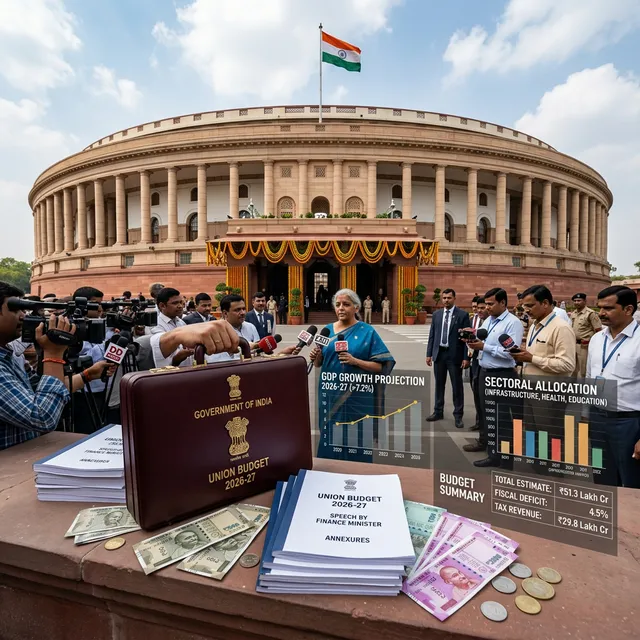
The Union Budget is India's most consequential annual economic document—a single, mammoth parliamentary exercise that simultaneously functions as a revenue forecast, an expenditure authorization, a policy manifesto, a political statement, a signal to global financial markets, and, for approximately 1.4 billion citizens, a deeply personal answer to the question: "Will the government make my life more or less expensive this year?" The Finance Minister's budget speech—typically delivered on February 1st, lasting roughly two hours, broadcast live on every major Indian television network—is one of the few annual events that simultaneously commands the attention of corporate boardrooms, street vendors, agricultural cooperatives, multinational investment banks, retired pensioners, and first-year economics students. Everybody watches. Everybody has opinions. And everybody computes, within hours, exactly how the budget changes their personal tax liability, their business costs, or their subsidy entitlements.
The Union Budget 2026-27 arrives in a specific economic context: India's GDP growth rate remains among the fastest of any major economy, but the quality of that growth—its distribution across income levels, its translation into formal employment, and its sustainability against global headwinds—faces intensifying scrutiny. The budget must simultaneously satisfy multiple, frequently contradictory constituencies: middle-class taxpayers demanding relief, industrialists demanding infrastructure investment, farmers demanding price support, fiscal conservatives demanding deficit reduction, and global rating agencies demanding debt sustainability. That the Finance Minister must address all of these expectations in a single document, funded by a single revenue pool, is the central, inherently impossible challenge of Indian budgetary politics.
Personal Income Tax: The Changes That Affect Your Salary

For the roughly 80 million Indians who file income tax returns, the personal income tax provisions are the budget's most immediately consequential component. The 2026-27 budget has introduced modifications to the New Tax Regime (NTR)—the simplified, lower-rate tax structure that the government has been actively encouraging taxpayers to adopt by making it the default option and progressively sweetening its terms relative to the Old Tax Regime with its complex deduction ecosystem.
The fundamental trade-off between the two regimes remains: the New Tax Regime offers lower headline tax rates but eliminates most of the deductions (Section 80C, 80D, HRA exemption, LTA, etc.) that salaried taxpayers in the Old Tax Regime use to reduce their effective tax liability. The budget's modifications—incrementally increasing the income thresholds at which higher tax rates kick in, and expanding the standard deduction—are designed to make the New Tax Regime unambiguously attractive for the majority of salaried taxpayers earning up to ₹15-20 lakh annually. For taxpayers with higher incomes and substantial existing investments in tax-saving instruments (PPF, ELSS, NPS), the calculation remains more nuanced and genuinely requires individual analysis.
The larger structural agenda behind the tax regime simplification is administrative efficiency. The Old Tax Regime's labyrinthine deduction ecosystem—involving documentation of house rent, insurance premiums, school tuition, home loan interest, charitable donations, and dozens of other expenditure categories—creates enormous compliance costs for taxpayers and verification burdens for the Income Tax Department. The New Tax Regime, by eliminating deductions and reducing rates, simplifies the filing process, reduces disputed assessments, and gradually moves India toward a cleaner, more transparent tax structure. Whether this simplification adequately compensates for the lost incentive to save (since tax-saving instruments like PPF and ELSS lose their tax advantage under the New Tax Regime) remains a legitimate, unresolved debate among economists.
Infrastructure: Where the Capital Expenditure Goes
The government's capital expenditure allocation—the budget provision for building physical infrastructure: highways, railways, ports, airports, urban transit systems, water supply networks—has been one of the most consistent and consequential features of recent Indian budgets. The 2026-27 allocation continues the aggressive expansion trajectory, with capital expenditure budgeted at approximately ₹11-12 lakh crore, representing roughly 3.3-3.5% of GDP.
The National Highway Authority of India (NHAI) continues its massive highway construction program—India has been building national highways at a rate of 25-30 kilometers per day, transforming intercity connectivity. Indian Railways' modernization—including the expansion of the Vande Bharat semi-high-speed train fleet, station redevelopment, and dedicated freight corridor completion—receives substantial allocation. Urban metro rail expansion in Tier-2 and Tier-3 cities (Lucknow, Kanpur, Nagpur, Patna, Ahmedabad) extends rapid transit beyond the major metros. The Jal Jeevan Mission—the ambitious program to provide piped drinking water to every rural Indian household—continues with multi-year funding commitments.
The infrastructure spending serves a dual purpose: creating the physical capital that enables long-term economic growth, and generating immediate employment in construction, materials, and associated industries during a period when private sector job creation in formal employment has been insufficient to absorb India's young, growing labour force. This "crowding in" strategy—where government infrastructure spending catalyzes private investment in adjacent sectors—is the economic logic underlying a capital expenditure program of this magnitude.
Agriculture and Rural Economy: The Political Bedrock
Agriculture remains the single most politically sensitive domain of Indian budgetary policy. Roughly 42% of India's workforce is employed in agriculture, yet agriculture contributes only about 15% of GDP—a structural imbalance that translates into persistently low agricultural incomes relative to urban employment. Every Union Budget must visibly address agricultural concerns, because the rural electorate constitutes a decisive voting bloc in Indian elections.
The PM-KISAN scheme—a direct income support program providing ₹6,000 annually to eligible farmer families—continues with its existing structure. The Minimum Support Price (MSP) framework for major crops has been incrementally increased, though the politically charged demand for a legal guarantee of MSP procurement—the core demand of the 2020-2021 farmer protests—remains unfulfilled. Agricultural credit targets, crop insurance subsidies (PM Fasal Bima Yojana), and investment in agricultural infrastructure (cold storage chains, food processing clusters, irrigation modernization) receive continued budgetary support.
The agricultural budget's fundamental tension is between income support (giving farmers money to compensate for low market prices) and structural transformation (investing in technology, market access, and value chains that would enable farmers to earn higher prices independently). Income support is politically expedient—it produces immediate, visible benefits before elections. Structural transformation is economically superior—it creates sustainable income improvement—but takes years to materialize and generates political credit only in the long term. Indian agricultural policy consistently favours the former over the latter, which is rational political strategy and arguably suboptimal economic strategy.
Fiscal Deficit: The Number That Markets Watch
The fiscal deficit—the gap between what the government earns (primarily through taxes) and what it spends—is the single number that international credit rating agencies, foreign institutional investors, and macroeconomic analysts scrutinize most intensely. The 2026-27 budget targets a fiscal deficit of approximately 4.5-4.8% of GDP, continuing the gradual fiscal consolidation trajectory from the pandemic-era peak of over 9% in 2020-21.
The tension is straightforward: every rupee allocated to infrastructure, welfare, defence, or subsidies increases the deficit unless offset by equivalent revenue growth. India's tax revenue has been growing robustly—driven by GST collection improvements, income tax base expansion, and corporate profitability—but the growth rate of expenditure demands consistently exceeds the growth rate of revenue. The fiscal deficit target thus functions as a discipline mechanism: it forces the government to prioritize among competing expenditure demands rather than funding everything through borrowing.
The macroeconomic significance of the fiscal deficit extends beyond accounting: a high deficit requires the government to borrow more from the domestic bond market, which pushes up interest rates (through increased demand for loanable funds), which increases the cost of borrowing for private businesses and individuals, which potentially dampens private investment and consumption. This "crowding out" effect creates a direct trade-off between government spending and private sector activity that is the central dilemma of expansionary fiscal policy in a developing economy.
Frequently Asked Questions (FAQs)
Which tax regime should I choose—Old or New?
The answer depends on your specific financial profile. If your total deductions under the Old Tax Regime (Section 80C investments, HRA exemption, home loan interest under Section 24, health insurance under Section 80D, NPS contributions under Section 80CCD) exceed approximately ₹3.75-4.5 lakh, the Old Tax Regime may still produce a lower tax liability. If your deductions are below this threshold—which is common for younger salaried employees without home loans or significant tax-saving investments—the New Tax Regime is almost certainly more beneficial. Many financial service providers offer free online calculators that compare your liability under both regimes using your actual income and deduction data.
Does the budget affect prices of everyday goods immediately?
Changes in excise duty and customs duty on specific products take effect from the budget date itself (April 1 or the date specified in the Finance Bill). Goods that become more expensive immediately include those with increased excise duty (historically, tobacco products, luxury items, and imported goods). GST rate changes, which are decided by the GST Council rather than the Union Budget, may follow separately. Basic food items, agricultural inputs, and essential goods are typically exempted from duty increases because of their political sensitivity. The net effect on daily household expenditure is usually modest for most families, though specific purchases (electronics, automobiles, imported goods) can see noticeable price changes.
Why does India still have such a complex tax system despite reform efforts?
India's tax complexity reflects the political challenge of transitioning from a system designed to incentivize specific behaviours (saving for retirement via PPF, purchasing health insurance via 80D, investing in infrastructure bonds, donating to charity) to a system designed for administrative simplicity. Each deduction represents a constituency that benefits from it and will politically resist its removal. The government's strategy has been to make the simplified New Tax Regime progressively more attractive rather than abolishing the Old Tax Regime's deductions outright—a gradualist approach that avoids immediate political backlash while steering taxpayer behaviour toward the simplified system over time.



Comments (0)
Be the first to share your thoughts on this article.