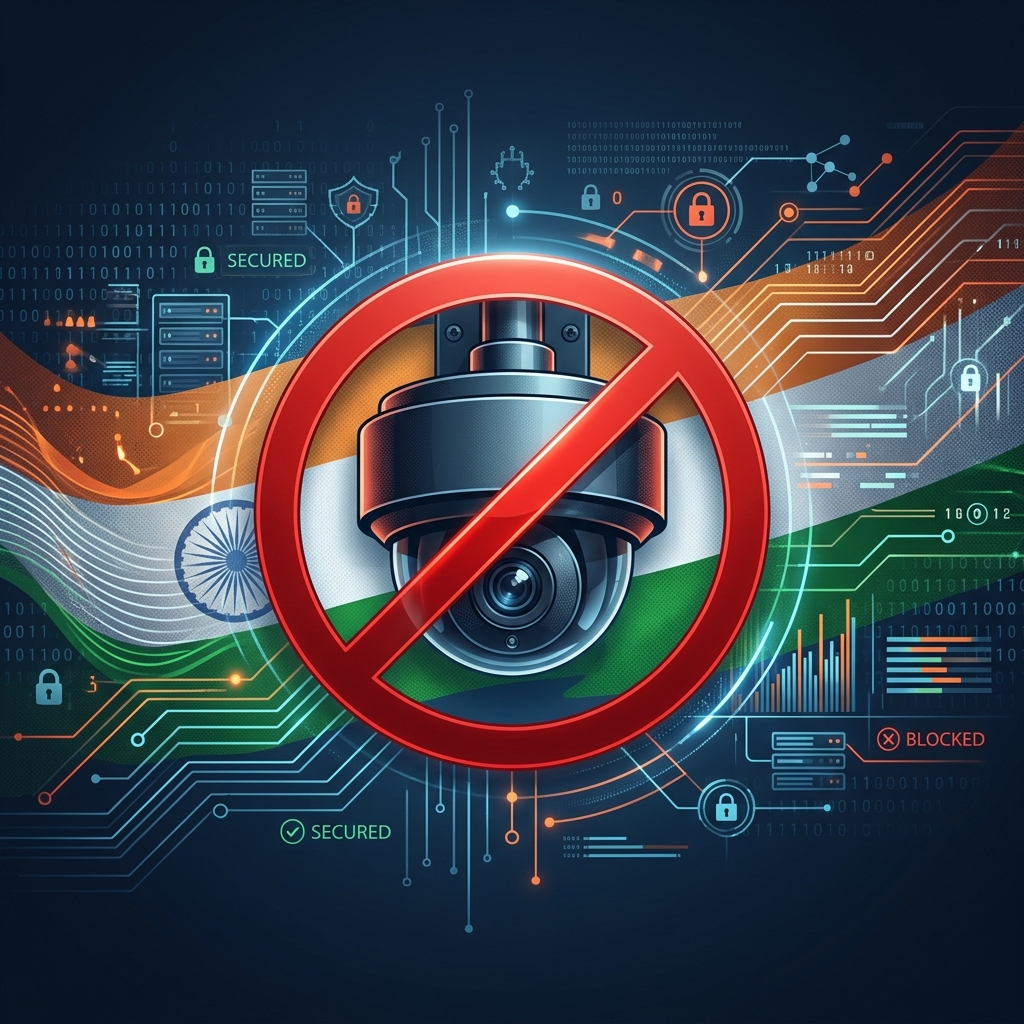
On March 30, 2026, India's Ministry of Electronics and Information Technology issued a notification that, stripped of its bureaucratic language, amounted to a remarkably consequential directive: effective April 1, 2026, the installation of CCTV cameras manufactured by companies incorporated in countries sharing a land border with India would require explicit government security clearance. The notification did not mention China by name—Indian government orders rarely do, preferring the geographically precise but diplomatically ambiguous formulation "countries sharing a land border"—but every person who read the order, from industry executives to cybersecurity researchers to the neighbourhood electrician who installs security cameras, understood precisely which country's products were being targeted. Hikvision and Dahua—two Chinese companies that collectively manufacture approximately 40% of the world's surveillance cameras and hold an estimated 50-60% market share in India's CCTV market—were, effectively, being shown the door.
This is not a small policy adjustment. India operates one of the world's largest and most rapidly expanding CCTV surveillance networks. The Safe City projects—government-funded urban surveillance programmes in Delhi, Mumbai, Hyderabad, Chennai, Lucknow, and dozens of other cities—have deployed millions of cameras for traffic monitoring, crime prevention, and public safety. Private sector installations—office buildings, residential societies, retail stores, hospitals, schools, warehouses, ATMs—add millions more. The banking sector alone operates an estimated 1.5 million CCTV cameras across branches and ATM locations. The total installed base of CCTV cameras in India is estimated at 15-20 million units, growing at 15-20% annually. A significant majority of these cameras are manufactured by Hikvision and Dahua, or are white-labelled products using Hikvision/Dahua hardware and firmware sold under Indian brand names.
Why Now: The Security Rationale

The decision to restrict Chinese CCTV cameras did not emerge from a vacuum. It is the latest in a series of technology sovereignty measures India has implemented since the Galwan Valley military confrontation with China in June 2020, which killed 20 Indian soldiers and fundamentally altered India's strategic calculus regarding technology dependence on Chinese companies. The chronology is important: the Galwan clash was followed by the ban on 59 Chinese mobile applications (including TikTok, WeChat, and UC Browser) in June 2020, followed by a broader ban on additional Chinese apps, followed by the restriction on Chinese telecom equipment (Huawei and ZTE) in India's 5G networks, followed by enhanced scrutiny of Chinese foreign direct investment requiring prior government approval, and now the CCTV restrictions. Each step has expanded the scope of technology domains from which Chinese companies are being progressively excluded.
The security rationale for CCTV camera restrictions is not speculative or paranoid—it is grounded in documented technical vulnerabilities and demonstrated exploitation capabilities. CCTV cameras are not simple optical devices; they are networked computers running complex firmware (embedded software), equipped with processing capabilities, connected to the internet or internal networks, and capable of transmitting data to remote servers. A modern IP-based CCTV camera is, from a cybersecurity perspective, a small computer with a lens attached—and like any networked computer, it is potentially vulnerable to remote exploitation.
The specific security concerns regarding Hikvision and Dahua products have been documented by cybersecurity researchers and government agencies worldwide. In 2021, the United States Federal Communications Commission designated Hikvision and Dahua as national security threats and prohibited the use of federal funds to purchase their equipment. The UK government directed its departments to cease deploying Hikvision cameras in "sensitive sites." Australia conducted a security audit that led to the removal of Chinese-manufactured cameras from government buildings. Multiple cybersecurity firms have documented critical vulnerabilities in Hikvision firmware—including a 2021 vulnerability (CVE-2021-36260) rated 9.8 out of 10 in severity, allowing remote attackers to gain full administrative control of the camera without requiring any authentication. Vulnerabilities of this severity are not typical software bugs; they represent potential surveillance backdoors—whether intentionally designed or resulting from negligent engineering practices.
For India, the specific concern is not that individual Chinese CCTV cameras are actively spying on Indian households—the volume of data from 15 million cameras would be impractical to monitor in real time. The concern is strategic: a network of millions of internet-connected Chinese cameras deployed across Indian critical infrastructure (military installations, government offices, airports, power plants, telecommunications facilities, financial institutions) creates a latent surveillance and disruption capability that could be activated during a geopolitical crisis. The Chinese National Intelligence Law of 2017 requires Chinese companies to "support, assist, and cooperate with" Chinese intelligence agencies—a legal obligation that applies to Hikvision and Dahua, both of which have documented ties to the Chinese government (Hikvision is majority-owned by the Chinese state through China Electronics Technology Group Corporation, CETC). The combination of documented technical vulnerabilities, legal intelligence cooperation obligations, and state ownership creates a risk profile that India's security establishment has concluded is unacceptable for critical infrastructure deployment.
The Indian Alternative: Who Fills the Gap?
The practical challenge created by the Chinese CCTV restriction is substantial: India does not currently have domestic manufacturers capable of producing surveillance cameras at the scale, price point, and technical capability of Hikvision and Dahua. Hikvision's dominance was built on three overwhelming advantages: Chinese government subsidies that enabled below-cost pricing in international markets, extraordinary manufacturing scale (Hikvision produces over 100 million cameras annually), and aggressive R&D investment in AI-powered video analytics (facial recognition, object detection, anomaly detection) that made their cameras the most feature-rich products available at any price point.
The Indian companies positioned to benefit from the Chinese exit include: CP Plus (India's largest domestic CCTV brand, though many of its products have historically used Chinese-manufactured hardware); Godrej Security Solutions (which manufactures a range of security products domestically); Sparsh CCTV (a newer entrant focused on Make in India manufacturing); and several smaller companies that assemble cameras from components sourced from non-Chinese suppliers (primarily South Korean, Taiwanese, and Japanese component manufacturers). Internationally, South Korea's Hanwha Vision (formerly Hanwha Techwin), Japan's Panasonic and Sony, Sweden's Axis Communications (owned by Canon), and US-based companies like Motorola Solutions and Honeywell offer alternatives, though typically at significantly higher price points than Chinese equivalents.
The price differential is the critical market challenge. A basic Hikvision IP camera suitable for home security retails for approximately ₹2,000-3,500 in India. A comparable camera from a non-Chinese manufacturer typically costs ₹5,000-12,000—a premium of 100-250% that is significant for the price-sensitive Indian consumer and catastrophic for the procurement budgets of government Safe City projects that need to deploy thousands of cameras. This price gap will narrow as Indian manufacturers scale up production and as PLI scheme incentives for electronic component manufacturing reduce domestic production costs, but the transition period—estimated at 18-36 months—will involve higher procurement costs, potential deployment delays for ongoing surveillance projects, and a temporary reduction in the technical capabilities available to Indian security systems (since Chinese cameras' AI-powered analytics are among the most advanced commercially available).
The Broader Pattern: India's Technology Decoupling From China
The CCTV restriction must be understood not as an isolated product-specific decision but as part of India's comprehensive, accelerating technology decoupling from China—a strategic reorientation that spans telecommunications infrastructure (5G network exclusion of Huawei and ZTE), mobile applications (200+ Chinese apps banned since 2020), foreign direct investment (mandatory government approval for Chinese investment), electronics manufacturing (PLI schemes designed to attract non-Chinese manufacturing to India), and now surveillance hardware. The cumulative effect is the progressive construction of a "digital border" that complements India's physical border—a technology sovereignty perimeter designed to ensure that India's critical digital infrastructure is not dependent on equipment manufactured by companies legally obligated to cooperate with the intelligence agencies of India's primary strategic adversary.
This technology decoupling has significant economic costs that India's policymakers have implicitly accepted as the price of strategic security. Chinese technology products—from smartphones (Xiaomi, Oppo, Vivo hold approximately 50% of India's smartphone market) to networking equipment to solar panels to CCTV cameras—are typically cheaper, more feature-rich, and more readily available than alternatives from democratic-country manufacturers. Restricting Chinese products means accepting higher procurement costs, longer deployment timelines, and potentially inferior technical capabilities in the short term, in exchange for reduced strategic vulnerability in the long term. The calculation is fundamentally about risk pricing: how much additional cost is justified by the elimination of a latent security risk that may never materialize but would be catastrophic if it did?
Frequently Asked Questions (FAQs)
Will existing Chinese CCTV cameras already installed in India be removed?
The current notification applies to new installations, not to the estimated 15-20 million Chinese cameras already deployed across India. Mandatory removal of existing cameras would be logistically impossible and financially prohibitive—the replacement cost alone would run into thousands of crores. However, the government has separately directed that Chinese cameras must be removed from "sensitive" installations—military facilities, government offices handling classified information, critical infrastructure sites, and certain financial sector installations. For private installations (homes, offices, shops, residential societies), existing Chinese cameras can continue to operate, but the government has recommended against connecting them to internet-facing networks and has issued cybersecurity advisories suggesting firmware updates and password changes. The practical effect will be a gradual replacement: as existing Chinese cameras reach end-of-life (typically 5-7 years), they will be replaced with non-Chinese alternatives, achieving a natural transition over the next decade.
Are my existing Hikvision/Dahua cameras actually spying on me?
The honest, evidence-based answer is: probably not actively, but they are potentially capable of it. There is no publicly documented evidence that Hikvision or Dahua cameras installed in Indian homes are actively transmitting video feeds to Chinese intelligence agencies. The documented vulnerabilities in these cameras' firmware are more likely the result of poor security engineering practices than intentional backdoors—though this distinction is less reassuring than it sounds, because the practical effect is identical: a remotely exploitable vulnerability allows unauthorized access regardless of whether it was designed intentionally or resulted from negligence. The pragmatic security recommendation is: if you operate Hikvision or Dahua cameras, ensure they are running the latest firmware, change default passwords, and ideally isolate them on a separate network segment from your primary internet-connected devices. These basic cyber hygiene practices substantially reduce (though do not eliminate) the exploit risk.
How does this compare to what other countries have done about Chinese surveillance technology?
India's approach is positioned between the most restrictive and most permissive international responses. The United States has imposed the most comprehensive restrictions: the FCC has banned the sale of new Hikvision and Dahua equipment, prohibited federal procurement, and restricted existing installations in government facilities. The United Kingdom has banned Chinese cameras from "sensitive government sites" but has not restricted private or commercial use. Australia has removed Chinese cameras from government buildings following a security audit. The European Union has issued advisories but has not implemented binding restrictions. India's approach—requiring government security clearance for new installations rather than an outright ban—is designed to provide regulatory flexibility while effectively blocking large-scale deployment. The practical effect is likely to be similar to a ban, since the security clearance process is expected to deny approval for Chinese products in most cases without creating the diplomatic confrontation of an explicit prohibition.

Comments (0)
Be the first to share your thoughts on this article.