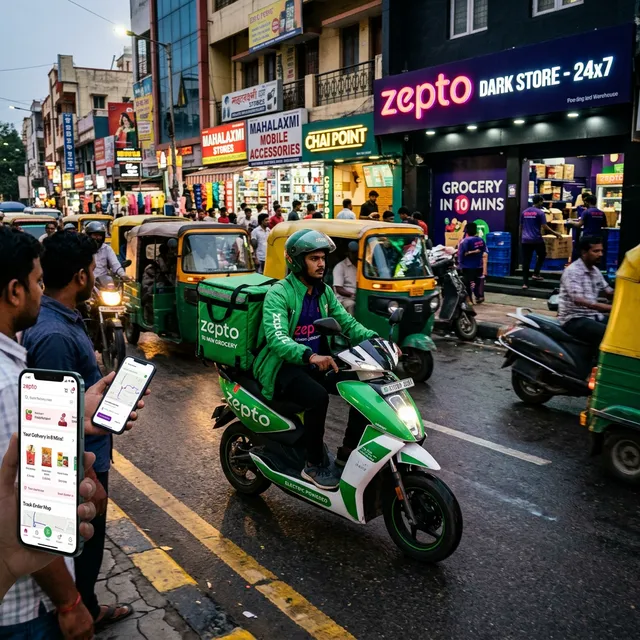
I ordered grocery delivery at 11:47 PM last Tuesday—not because I needed anything urgently, but because I could. Two packets of milk, a bar of dark chocolate, and a bag of chips arrived at my door in nine minutes. Nine minutes. The delivery rider, a young man on an electric scooter with a fluorescent green backpack, handed me the bag, flashed an exhausted smile, and was gone before I could fumble for a tip. I stood in my doorway holding a bag of groceries I didn't urgently need, delivered at a speed I hadn't asked for, by a person working at midnight on a Tuesday, and experienced the particular modern discomfort of simultaneously enjoying a service and questioning the entire system that produces it.
Quick commerce—the category of delivery services that promise groceries, household essentials, and increasingly, almost anything, delivered in 10-30 minutes—has become India's most culturally contentious, economically fascinating, and strategically uncertain technology sector. In 2025, India's quick commerce market crossed $6 billion in annualized gross merchandise value. Blinkit (owned by Zomato), Zepto, and Swiggy Instamart—the three dominant platforms—collectively fulfil millions of orders daily. The growth rate is staggering: the market has roughly tripled in two years. The consumer adoption is undeniable. The fundamental question—whether this is a sustainable business or a venture-capital-funded exercise in subsidizing urban convenience at the expense of everyone involved in the supply chain—remains genuinely, unsettlingly unresolved.
How Quick Commerce Actually Works: The Dark Store Model

Understanding why quick commerce generates such passionate debate requires understanding its operational architecture—because the entire model's economics, labour implications, and urban impact flow directly from a single structural decision: the dark store.
A dark store is a small warehouse—typically 2,000-4,000 square feet, located in a residential or commercial neighbourhood—that exists solely to fulfil delivery orders. It is not a retail shop; customers cannot walk in and browse. It is a hyper-localized micro-warehouse stocked with 3,000-6,000 SKUs (stock keeping units), strategically positioned so that its delivery radius covers a 2-3 kilometer area. Each dark store is essentially a miniature, neighbourhood-scale Amazon fulfilment centre. The location strategy is the critical competitive variable: the closer the dark store to the customer, the shorter the delivery time, and the lower the per-delivery logistics cost (because the rider covers less distance). Blinkit operates over 800 dark stores across Indian cities. Zepto operates approximately 500. Swiggy Instamart operates around 600. These numbers are expanding aggressively—each company opens multiple new dark stores weekly.
The delivery speed promise—10 minutes from order placement to doorstep—is achieved through four simultaneous optimizations: hyper-local inventory positioning (the goods are already 2-3 km from the customer), pre-packed order preparation (warehouse staff begin assembling the order within seconds of receiving it, guided by a handheld device that specifies exact shelf locations), rider pre-positioning (delivery riders wait at or near dark stores during peak hours, ready for immediate dispatch), and algorithmic routing (the delivery app calculates the fastest route considering real-time traffic, rider location, and order batching possibilities). The entire process—from the customer tapping "Place Order" on their phone to the rider pressing "Delivered" at the doorstep—is designed to compress every possible second of latency.
The Economics: Who Pays for Ten-Minute Delivery?
The fundamental economic question of quick commerce is brutally simple: does the revenue generated by each delivery cover the cost of providing that delivery? The honest answer, three years into the quick commerce experiment, is: it depends on how you define "cover" and which costs you include.
The unit economics equation for a single quick commerce delivery includes: the gross margin on products sold (typically 15-25% for groceries, higher for packaged foods and personal care items, negligible for staples like milk and eggs that are priced competitively to drive traffic); the delivery fee charged to the customer (₹0-49 depending on order value, with free delivery increasingly common above ₹199-299); the platform fee (₹2-10 per order); the advertising revenue from brands paying for product placement within the app; minus the cost of last-mile delivery (rider compensation per trip: ₹15-35 depending on distance); minus the dark store operating cost (rent, electricity, staff, inventory carrying costs, wastage on perishable goods); minus the technology and corporate overhead allocated per order.
At current scale, Blinkit—the market leader by GMV—has achieved contribution-margin positivity on a per-order basis, meaning the direct revenue per order exceeds the direct variable cost of fulfilling that order. This is a genuine, meaningful milestone. However, contribution-margin positivity does not include fixed costs (dark store rent, corporate salaries, technology infrastructure, marketing spend), and it is achieved partly through aggressive growth in average order value (AOV)—currently ₹550-650 for Blinkit—driven by the addition of higher-margin product categories (electronics, beauty products, toys, small appliances) alongside low-margin groceries. The strategic pivot from "10-minute grocery delivery" to "10-minute everything delivery" is fundamentally a margin improvement strategy disguised as a convenience expansion.
The deeper economic question is whether quick commerce creates genuine value or merely redistributes existing retail spending through a more capital-intensive channel. When a customer orders a ₹25 packet of biscuits through Blinkit instead of buying it from the kirana store 100 meters away, the biscuit manufacturer's revenue is identical—only the distribution channel has changed, with the addition of a dark store, a delivery rider, a technology platform, and venture capital subsidizing the logistics cost. The consumer gains convenience. The kirana store loses a sale. The platform burns capital on the delivery. The rider earns a minimal per-trip fee. The net economic value creation, as distinct from value redistribution, is debatable.
The Labour Question: What Quick Commerce Means for Gig Workers
Behind every 10-minute delivery is a delivery rider—overwhelmingly a young man in his twenties, frequently a migrant from a smaller town or rural area, working on a gig-economy contract that provides per-delivery compensation without the employment benefits (health insurance, paid leave, provident fund, job security) that formal employment provides. The quick commerce rider's working conditions have become the sector's most urgent ethical flashpoint.
The per-delivery compensation model creates an inherent incentive structure that prioritizes speed over safety. Riders who complete more deliveries per hour earn more. The platform's algorithms penalize late deliveries (reducing future order allocation to consistently slow riders) and reward fast ones. The result is predictable: riders racing through traffic, running red lights, riding on footpaths, and taking risks that are individually rational (earning more money) and collectively dangerous (creating road safety hazards). Multiple delivery rider fatalities have been documented across Indian cities, though comprehensive accident data for gig delivery workers remains inadequately collected.
The earnings economics are equally concerning. A full-time quick commerce delivery rider working 10-12 hour shifts can earn ₹15,000-25,000 monthly—income that appears reasonable until you account for the costs the rider bears: motorcycle or scooter EMI payments, fuel costs (for petrol-powered vehicles), phone and mobile data expenses, and the opportunity cost of the physical wear and working hours. The effective hourly wage, after deducting rider-borne expenses, frequently falls below minimum wage levels in metropolitan cities. The gig economy classification—these workers are "partners" not "employees"—removes the legal obligation to provide minimum wage guarantees, overtime compensation, health insurance, or retirement benefits.
The Kirana Store Impact: Disruption or Coexistence?
India has approximately 12 million kirana stores—small, family-owned neighbourhood retail shops that collectively constitute the world's largest unorganized retail network. These stores provide employment (directly and indirectly) to over 40 million people. They operate without external capital, without technology platforms, without dark stores—surviving on personal relationships with customers, hyper-local inventory knowledge (the kirana store owner who knows that Mrs. Sharma buys Amul Gold milk every morning and reserves a packet for her), and negligible overhead costs (the store is typically the ground floor of the owner's house, staffed by family members, requiring no delivery infrastructure).
The quick commerce platforms' impact on kirana stores is not hypothetical—it is documented and accelerating. A 2024 survey by the All India Consumer Products Distributors Federation reported that kirana stores in areas with high quick commerce dark store density experienced 10-30% revenue declines in specific product categories—particularly packaged foods, beverages, personal care, and household cleaning products, which are precisely the high-margin categories that cross-subsidize the kirana store's low-margin staples business. The stores are not losing customers who need emergency milk at midnight; they are losing the ₹200 "top-up" shopping trips—the impulse purchases, the "pick up a few things" occasions—that constitute a significant portion of their daily revenue.
The counterargument—that quick commerce serves a different convenience segment and the overall retail market is growing fast enough to accommodate both channels—has some validity. India's total retail market exceeds $900 billion annually and is growing at 8-10% per year. Quick commerce, at $6 billion, represents less than 1% of total retail. In aggregate, the kirana sector is not facing existential threat. But aggregates conceal distributional impact: the kirana stores in metropolitan neighbourhoods with multiple competing dark stores are being squeezed, while kirana stores in smaller towns without quick commerce presence are unaffected. The impact is geographically concentrated and economically significant for the affected stores.
The Urban Infrastructure Burden
Quick commerce's externalities extend beyond labour and retail competition to the physical urban environment. Dark stores—which require ground-floor commercial space in residential neighbourhoods, frequent large-vehicle deliveries for inventory replenishment, and dozens of delivery riders congregating outside during peak hours—create neighbourhood-level disruption that residents are increasingly vocal about. Complaints include: increased traffic congestion from delivery riders and supply trucks, noise pollution from late-night and early-morning operations, conversion of neighbourhood retail spaces into windowless warehouses that reduce street-level vitality, and parking congestion from rider vehicles. Multiple Resident Welfare Associations in Delhi-NCR, Mumbai, and Bangalore have petitioned municipal authorities to restrict dark store operations in residential zones.
Frequently Asked Questions (FAQs)
Is 10-minute delivery actually necessary, or is it manufactured urgency?
This is the philosophical question at the heart of quick commerce, and the honest answer is: it is both. For certain use cases—a cooking ingredient you've run out of mid-preparation, urgent baby supplies at 2 AM, medication for a sick family member—rapid delivery provides genuine, unambiguous utility. For the majority of orders—replacing a routine shopping trip with an app tap because it's marginally more convenient—the 10-minute promise is less about necessity and more about habituating consumers to a speed standard that creates switching costs (once you're accustomed to 10-minute delivery, waiting 30 minutes feels unacceptable, and visiting a store feels absurd). The manufactured urgency critique has merit: quick commerce platforms actively cultivate impatience because impatience drives order frequency.
Will quick commerce companies ever become genuinely profitable?
The path to profitability exists but requires several conditions that are not yet fully met: consistently high average order values (₹600+ per order to generate sufficient gross margin); advertising revenue maturation (brands paying for product placement, sponsored search results, and promotional slots within the app—a revenue stream that is growing rapidly and carries near-100% margins); reduction in delivery cost per order through higher order density per dark store (more orders from the same location reduce the per-order allocation of fixed costs); and eventual reduction in customer acquisition costs as the market matures and organic retention improves. Blinkit's trajectory suggests this is plausible. Whether it is achievable for all three major platforms simultaneously—or whether the market can sustain only one or two profitable operators—is the key competitive uncertainty.
Should I be worried about quick commerce as a kirana store owner?
If your store is located in a Tier-1 city residential neighbourhood with multiple dark stores within 3 km radius, the revenue impact on packaged goods and household essentials is real and likely to intensify. The strategic response is to double down on what quick commerce structurally cannot replicate: personal customer relationships (credit accounts, personalized service, festival gift recommendations), fresh produce quality (customers who want to personally inspect vegetables and fruits before buying), and hyper-local specialization (regional products, loose grains and pulses, local dairy brands that dark stores don't stock). If your store is in a Tier-2 or Tier-3 city, quick commerce penetration remains limited and the near-term impact is negligible, though this will change over the next 3-5 years as platforms expand to smaller cities.


Comments (0)
Be the first to share your thoughts on this article.