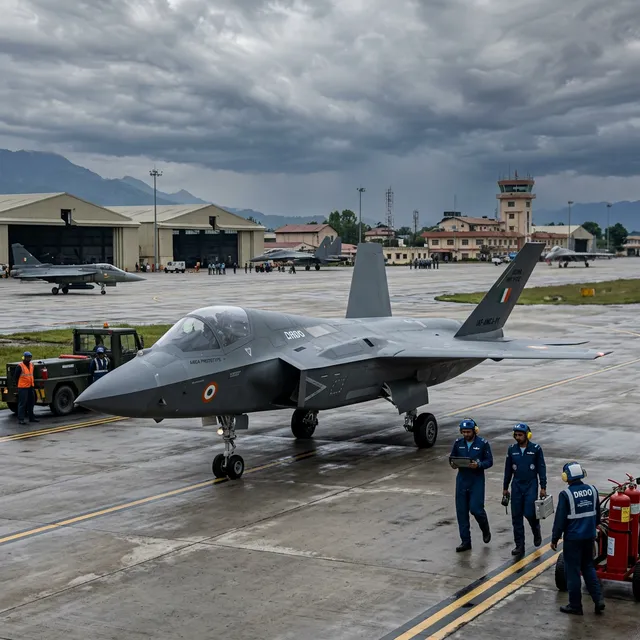
India is attempting something that only five countries in the history of manned flight have accomplished: designing and building a fifth-generation stealth fighter aircraft entirely through indigenous engineering. The Advanced Medium Combat Aircraft—AMCA—is not merely another defence procurement project with a Sanskrit acronym. It is India's most technologically ambitious, strategically consequential, and financially demanding indigenous military program, a generational engineering challenge that will test the absolute limits of India's aerospace manufacturing capability, metallurgical science, avionics integration expertise, and institutional capacity for managing complex, multi-decade technology development programs. The aircraft, if successfully developed and inducted into the Indian Air Force, would place India in an exclusive club alongside the United States (F-22 Raptor, F-35 Lightning II), Russia (Su-57 Felon), China (J-20 Mighty Dragon, J-35), and arguably South Korea (KF-21 Boramae, though its stealth classification is debated). Every other country on Earth—including the entire European Union, Japan, and the United Kingdom—has either abandoned independent fifth-generation fighter development or partnered with other nations to share the prohibitive costs.
Understanding why India is pursuing the AMCA requires understanding the strategic context that makes it necessary. The Indian Air Force currently operates approximately 30 fighter squadrons against a sanctioned strength of 42—a deficit that has persisted for over a decade and shows no sign of closing through imports alone. The IAF's frontline fleet consists predominantly of Russian-origin Su-30MKI heavy fighters (approximately 260 aircraft), French-origin Rafale omnirole fighters (36 aircraft with additional orders pending), domestically produced HAL Tejas light combat aircraft (with orders for over 200 in various configurations), and aging MiG-29 and Mirage 2000 platforms approaching retirement. Against this force, India faces two nuclear-armed adversaries with rapidly modernizing air forces: China, which operates over 150 J-20 stealth fighters and is developing the J-35 for carrier operations, and Pakistan, which operates JF-17 Thunder fighters and has expressed interest in acquiring Chinese fifth-generation aircraft.
The stealth capability gap is the critical strategic problem. Fourth-generation fighters—regardless of how extensively they are upgraded with new radars, electronic warfare suites, and precision munitions—are fundamentally detectable by modern air defence systems. Their radar cross-section (a measure of how visible they are to enemy radar) is measured in square meters. A fifth-generation stealth fighter's radar cross-section is measured in fractions of a square meter—sometimes approaching the radar signature of a small bird. This difference is not incremental; it is categorical. A stealth fighter can penetrate defended airspace, engage targets, and withdraw before non-stealth opponents even detect its presence. Against an adversary equipped with advanced surface-to-air missile systems (like the Russian S-400, which both India and China have purchased), operating non-stealth aircraft in contested airspace becomes increasingly suicidal.
The AMCA's Design Philosophy: What Makes It Fifth-Generation

The term "fifth-generation fighter" is not marketing language—it describes a specific, technically defined set of capabilities that collectively represent a qualitative leap over fourth-generation aircraft. The AMCA is being designed to incorporate all of these defining characteristics:
Low-Observable (Stealth) Design: The aircraft's external shape is engineered from the earliest design stage to minimize radar reflection. This involves eliminating right-angle surfaces that strongly reflect radar waves, using internal weapons bays (carrying missiles and bombs inside the fuselage rather than on external pylons that create massive radar returns), employing S-shaped engine inlet ducts that hide the highly radar-reflective engine compressor face from frontal radar illumination, and applying radar-absorbing materials (RAM) and coatings to the aircraft's skin. The AMCA's planform—its shape when viewed from above—features the characteristic blended wing-body design, canted tail surfaces, and smooth, faceted surfaces that characterize every stealth aircraft from the F-22 to the J-20. Achieving genuine low-observable performance is not primarily a design challenge (the principles are well-understood) but a manufacturing precision challenge: every panel, rivet, access door, and surface joint must be manufactured and sealed to tolerances measured in fractions of a millimeter, because even tiny gaps and misalignments create radar reflections that degrade stealth performance.
Sensor Fusion: A fifth-generation fighter does not merely carry advanced sensors; it integrates data from multiple sensor systems—active electronically scanned array (AESA) radar, infrared search and track (IRST) systems, electronic warfare receivers, datalink inputs from other aircraft and ground stations—into a single, unified tactical picture presented to the pilot on panoramic cockpit displays. The pilot does not manually correlate information from separate radar, infrared, and electronic warfare screens (as in fourth-generation fighters); the aircraft's mission computer automatically fuses all sensor inputs, identifies and prioritizes threats, and recommends engagement solutions. This sensor fusion capability is arguably more important than stealth itself—it provides the pilot with situational awareness that is orders of magnitude superior to any fourth-generation aircraft, regardless of how advanced the individual sensors on the older aircraft might be.
Supercruise Capability (Mark 2): The AMCA is planned in two variants. The Mark 1 will use two General Electric GE-414 engines (the same engine powering the F/A-18 Super Hornet)—a proven, reliable powerplant that enables the aircraft to fly while indigenous engine development continues. The Mark 2 will incorporate a domestically developed engine with significantly higher thrust, enabling supercruise—the ability to sustain supersonic flight without using fuel-intensive afterburners. Supercruise allows the aircraft to transit to combat zones faster, engage and disengage at supersonic speeds, and operate at sustained supersonic velocity without the enormous fuel penalty that afterburner use imposes. Only the F-22 Raptor currently achieves genuine supercruise in operational service.
The Indigenous Engine Challenge: India's Hardest Engineering Problem
If the AMCA's airframe represents India's most ambitious aerospace engineering project, the indigenous engine that will power the Mark 2 variant represents something considerably more difficult. Jet engine development is, by a substantial margin, the most technically demanding discipline in all of mechanical engineering. The core of a modern military turbofan engine operates at temperatures exceeding 1,700°C—above the melting point of the nickel-based superalloys from which the turbine blades are manufactured. The blades survive only through extraordinarily sophisticated internal cooling channel architectures (cast as single crystals to eliminate grain boundary weaknesses) and thermal barrier ceramic coatings measured in microns. Each turbine blade experiences centrifugal forces equivalent to hanging a large SUV from it while simultaneously being bathed in gas hotter than the melting point of its own material.
Only four entities on Earth have demonstrated the ability to independently develop and produce high-performance military turbofan engines: the United States (Pratt & Whitney and General Electric), the United Kingdom (Rolls-Royce), Russia (Saturn/UEC), and France (Safran). China has spent over $20 billion and two decades attempting to develop indigenous high-performance military engines and is only now approaching serial production capability with the WS-15 for the J-20. India's GTRE (Gas Turbine Research Establishment) has been developing the Kaveri engine since the 1980s—a program that has produced genuinely valuable engineering knowledge and several working prototypes but has not yet delivered a flight-qualified engine meeting the IAF's performance requirements.
The AMCA Mark 2 engine program represents India's recognition that an indigenous fifth-generation fighter without an indigenous engine is strategically incomplete—it remains dependent on a foreign country's willingness to supply the aircraft's most critical component. The partnership with Safran (France) for joint development of the AMCA engine is a pragmatic strategy: it provides access to Safran's world-class hot-section metallurgy and turbine design expertise while building Indian engineering capacity through technology transfer and joint development, with the explicit goal of achieving fully independent engine development capability for future programs.
Where India Stands in 2026: Timelines and Reality
The AMCA received formal Cabinet Committee on Security (CCS) approval in March 2024, with a development budget of approximately ₹15,000 crore for the design, development, and production of five prototype aircraft. The first prototype flight is targeted for 2028-2029, with the Mark 1 variant (using GE-414 engines) expected to enter limited series production by 2032-2034 and the Mark 2 variant (with the indigenous/joint-developed engine) following by 2035-2037.
These timelines should be understood as aspirational rather than committal. India's track record with indigenous fighter development—the LCA Tejas program took over 30 years from project sanction to operational squadron induction—provides both cautionary precedent and genuine reason for optimism. The Tejas program's delays were largely attributable to India's complete lack of fighter aircraft design experience at the program's inception in the 1980s. The engineers who designed the Tejas literally had to learn fighter design from first principles. The AMCA program benefits from three decades of accumulated engineering knowledge, computational design tools, wind tunnel testing infrastructure, and flight testing experience developed during the Tejas program. The same engineers and institutions that struggled through the Tejas program's early decades are now senior experts with battle-tested (figuratively) experience in every aspect of fighter aircraft development.
HAL's production capabilities have also matured significantly. The Tejas Mark 1A production line at Bangalore is being expanded to deliver 16 aircraft per year—a production rate that, while modest by American or Chinese standards, represents a genuine industrial capability that did not exist a decade ago. The AMCA production facility will build on this industrial base while incorporating more advanced manufacturing technologies—additive manufacturing (3D printing) for complex structural components, automated fibre placement for composite structures, and robotic assembly systems for precision stealth-surface fitting.
The Geopolitical Dimension: Why AMCA Matters Beyond Air Combat
The AMCA's strategic significance extends far beyond its eventual military capability. The program is fundamentally about India's position in the emerging geopolitical order where advanced military technology development capability serves as both a deterrent and a diplomatic lever. Countries that can independently develop fifth-generation fighters do not depend on any other country's political goodwill for their air defence capability. This independence is not theoretical—India experienced its consequences directly when the United States imposed technology sanctions following India's 1998 nuclear tests, disrupting multiple defence procurement programs. An India that can build its own stealth fighter is an India that no external power can coerce through technology denial.
The AMCA program also generates enormous industrial spillover effects. The advanced materials, manufacturing processes, avionics systems, and engineering expertise developed for the program cascade into civilian aerospace, space technology, and advanced manufacturing sectors. Countries with mature fighter aircraft development programs—the US, France, the UK, Sweden—invariably have world-class civilian aerospace industries, and the causal connection between military aerospace R&D and civilian technology capability is well-documented.
Frequently Asked Questions (FAQs)
How does the AMCA compare to the Chinese J-20 and the American F-35?
Direct comparison requires significant caveats because the AMCA exists as a design and prototype program while the J-20 and F-35 are operational aircraft with established performance records. In terms of design generation, the AMCA incorporates fifth-generation features comparable to both: internal weapons bays, low-observable shaping, sensor fusion, and AESA radar. In terms of size and role, the AMCA (medium weight, twin-engine) is positioned between the heavy J-20 and the lighter single-engine F-35A. The critical differentiator will be the quality of the avionics suite, sensor fusion software, electronic warfare systems, and the stealth manufacturing precision—areas where operational experience and iterative refinement matter enormously and where India will inevitably lag behind the US and China for the initial production variants. The Mark 2 variant with an indigenous engine and more advanced avionics is where the AMCA is expected to approach genuine parity.
Why doesn't India simply buy a stealth fighter from the US or another country instead of building one?
Three reasons. First, no country sells its most advanced stealth fighters—the US has never exported the F-22 Raptor (its sale is literally prohibited by US law), and the F-35 comes with extensive technology restrictions, data-sharing requirements, and political conditions that India considers incompatible with strategic autonomy. Second, dependence on imported fighters creates permanent vulnerability to supply chain disruption—spare parts, ammunition, software updates, and maintenance support can be withheld as political leverage during geopolitical crises, precisely when the aircraft are most needed. Third, the industrial capability developed through indigenous production—the engineering talent, manufacturing infrastructure, supply chain development, and technology base—has enormous long-term economic value that imported equipment simply does not generate. Buying a fighter is a transaction; building a fighter is an investment in industrial capability.
What is the biggest risk to the AMCA program's success?
The single biggest risk is not technical but institutional: maintaining consistent funding, political commitment, and organizational focus across the 15-20 year development timeline that a program of this complexity requires. Fighter development programs are inherently multi-decade endeavours that span multiple government terms, multiple service chiefs, and multiple budget cycles. The temptation to divert funding to more immediately visible procurement programs, to change requirements mid-development (the single most destructive thing that can happen to an engineering program), or to lose institutional patience with the inevitable delays and setbacks is the risk that has historically derailed indigenous defence programs worldwide. The AMCA program's success depends less on engineering brilliance (which India demonstrably possesses) and more on institutional discipline (which India has historically struggled with in long-duration programs).


Comments (0)
Be the first to share your thoughts on this article.