
My first serious attempt at a gym membership started in January 2023, fueled by New Year aesthetics and a brand-new pair of running shoes. I went exactly four times — total, not per week. By February, the only exercise I got from that expensive membership was the psychological gymnastics of justifying why seeing the $60 charge on my credit card statement every month was somehow "keeping me committed." I finally cancelled it in April. And honestly? I deserved that failure, because I was doing everything fundamentally wrong.
Not "wrong" in the motivational-poster sense of "not believing in myself." I was wrong in the cold, hard engineering sense. I was designing a behavioral system that was guaranteed to fail, and then blaming my lack of willpower when the system did exactly what poorly designed systems always do: break down under pressure.
Three years later, my reality looks entirely different. I exercise five days a week with a consistency that feels entirely effortless. Not at a boutique gym, but at home, with a $15 yoga mat, two adjustable dumbbells, and a pull-up bar. The difference wasn't a sudden spike in discipline or a biological shift in my motivation levels. The difference was a complete paradigm shift in how I viewed habits: I stopped relying on willpower and started actively manipulating friction.
The Friction Framework Nobody Talks About
Most popular habit advice operates on a deeply flawed willpower model: you decide to do the thing, you pump yourself up with motivation, and then you force yourself to do it over and over until it magically becomes automatic. This model is scientifically questionable and practically useless for 99% of people.
Why? Because willpower is a highly volatile, depletable resource. You have high willpower at 8:00 AM after a coffee. You have near-zero willpower at 6:30 PM after a grueling meeting with your boss. Building sustainable habits requires consistency over months — far longer than any reservoir of sheer willpower can physically sustain.
What actually works is identifying the barriers between you and the action, and relentlessly eliminating them. I classify these barriers into three distinct types of friction:
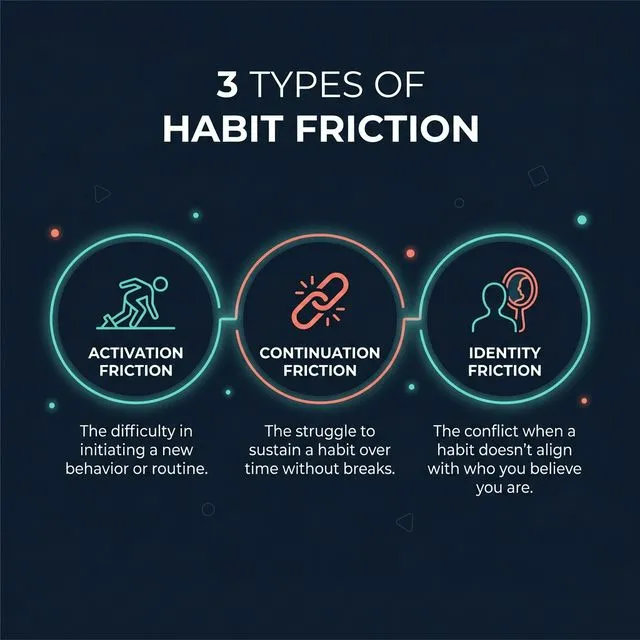
1. Activation Friction
The hardest part of going to the commercial gym was never the actual workout doing squats or bench presses. It was the logistics: finding my keys, driving in traffic, searching for parking, changing in a locker room that smelled vaguely of despair, waiting 15 minutes for the one squat rack to open up, and then reversing the entire miserable process afterward. The workout itself was maybe 40 minutes. The overhead was 50 minutes. I was spending more time navigating logistics than I was exercising.
When I switched to home workouts, the activation friction dropped to approximately zero. I roll out of bed, put on gym shorts, and walk exactly six feet to the mat in my living room. That singular reduction in friction made the habit roughly ten times more sustainable. It wasn't because I became a more disciplined person overnight; it was because there was simply less to be disciplined about.
2. Continuation Friction
We've all been there: You start strong. Day one, day two, day three — you're absolutely crushing it. You feel unstoppable. But then day seven arrives, and something comes up. Your kid gets sick, or you have to stay late at work. Day eight, you're "too tired" to catch up. Day twelve, you've completely forgotten the habit even exists. Sound vaguely familiar?
Continuation friction usually means the baseline requirement for the habit is far too ambitious. I once tried building a journaling habit by committing to writing for 30 minutes daily. I lasted exactly nine days before burnout hit. Three years later, I tried again, but I switched the commitment to just three sentences daily. I've now hit over 400 consecutive days of journaling.
The secret? The three sentences often organically turn into a full, sprawling page once I'm in the flow, but the *binding commitment* is only three sentences. On truly terrible days — the ones where you're exhausted and just want to sleep — I write three mediocre, uninspired sentences, close the notebook, and I still get to count it as a win. Continuation friction is destroyed.
3. Identity Friction
This is the most subtle, yet powerful friction of all. If you secretly believe deep down that you're "just not a morning person," attempting to wake up at 5:00 AM will constantly feel like you're wearing an ill-fitting costume. You might manage it for a week or two through sheer force, but eventually, you'll revert to who you genuinely believe you are. The established identity wins every single time.
Changing the identity has to come first, or at least concurrently with the habit. And you don't do this through reciting cheesy affirmations into a bathroom mirror — you do it through gathering undeniable evidence. Every single morning you wake up early is a data point that updates your internal self-model. You're not pretending to be a morning person; you're actively collecting tangible evidence that you might actually be one.
The Transformative Power of the Two-Minute Principle
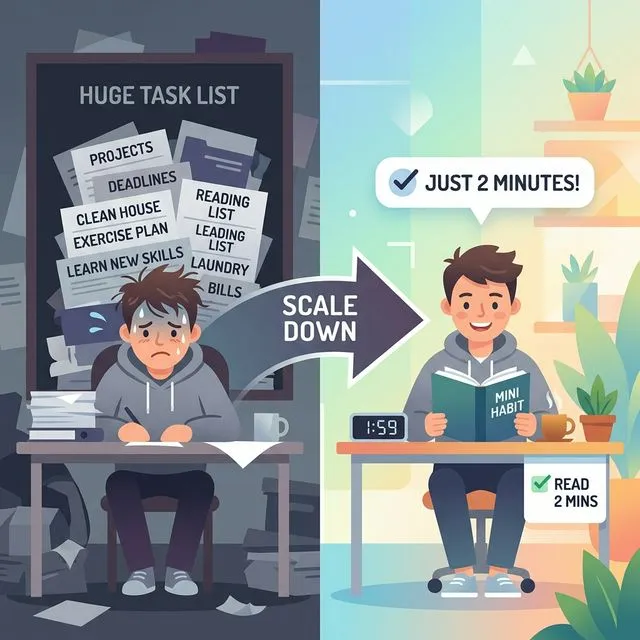
Author James Clear popularized this concept in his book Atomic Habits, and it's genuinely the most pragmatic habit advice I've ever encountered. The rule states that any new habit should be reducible to a version that takes two minutes or less to accomplish.
- "Read 30 books a year" becomes "Read one single page before bed."
- "Exercise for an hour daily" becomes "Do five push-ups."
- "Meditate for 20 minutes" becomes "Sit quietly with your eyes closed for 120 seconds."
I actively resisted this for months because my ego told me it felt patronizing. Five push-ups? That's not a real workout. One page? That's barely reading. But I was fundamentally confusing the *habit* with the *desired outcome*. The habit isn't the muscle mass or the finished book; the habit is the pure behavioral pattern. Showing up, doing the thing, at the same time, in the same context, consistently. The volume and intensity can scale later. First, you desperately need to forge the neural pathway.
My own reading habit restarted with the commitment of exactly one page before sleep. Within two weeks, I was naturally reading 15 to 20 pages because once you conquer the activation friction, momentum takes over. But the strict baseline commitment remained one page. On nights when my eyes were heavy, I read one page, placed the bookmark, and went to sleep with my streak pristine. That unbroken streak is exactly what eventually made picking up the book feel entirely automatic.
Environment Design Will Always Beat Willpower
Here is an absolute truth drawn from years of my own failures that might save you immense frustration: Your physical environment is vastly stronger than your best intentions. Every time. Without exception.
When I wanted to clean up my diet, I didn't rely on staring longingly at donuts and forcing myself to say no. I completely reorganized the geography of my kitchen. Fresh fruits went into a beautiful bowl dead-center on the counter. The salty chips and hyper-processed snacks went to the highest, most inaccessible shelf in the very back of the darkest pantry closet.
Did I do this because I physically couldn't reach them? No. I did it because the extra ten seconds of physical effort, plus the annoyance of finding a step-stool, was just enough friction to make my brain pause and reconsider whether I actually wanted the chips, or if I was simply bored. More often than not, it was boredom.
I applied the exact same principle to combat my smartphone addiction. I moved all social media apps off my home screen, buried them on the fourth page deep inside a vaguely named folder. I added a strict 15-minute daily limit through Apple's Screen Time UI. The apps were still there if I needed them — they were just slightly less convenient to access. My daily screen time plummeted from roughly 4.5 hours down to about 1.5 hours within a single month.
Remember: Willpower is an emergency brake meant for rare situations. Environment design is the steering wheel for your daily systems.
The Recovery Protocol: What Happens When You Miss a Day?
Let’s be honest: You will miss a day. Probably several. The core question isn't how to magically prevent missing (you can't — life is inherently chaotic, kids get sick, flights get delayed) but how you mentally respond when the inevitable miss occurs.
My golden, non-negotiable rule is: Never miss twice.
One miss is an accident; it's a blip in the radar. Two consecutive misses is the birth of a brand new, negative pattern. So if I skip my scheduled workout on Thursday, Friday becomes mandatory. Not Thursday's makeup workout *plus* Friday's regular workout — just Friday's normal session. The psychological goal is to prioritize re-engagement over punishment.
The trap most people fall victim to is known in psychology as the "what the hell" effect. You miss one day on your diet, you feel a wave of intense guilt, you decide the perfect streak is already broken, so "what the hell," you eat an entire pizza and abandon the habit entirely for the next six months. This toxic, all-or-nothing black-and-white thinking is the single biggest killer of nascent habits. A 90% consistency rate spread over an entire year is infinitely more valuable than a flawless 100% rate that only lasts for two weeks before crashing to zero.
Honest Limitations & Edge Cases
While everything above holds true for most scenarios, it would be disingenuous to claim this framework is flawless for everyone, everywhere. There are highly specific edge cases where standard habit-building advice breaks down.
Pros of this framework: - Completely bypasses the need for high motivation. - Scales beautifully for busy professionals and parents. - Protects your mental health by removing guilt from the equation.
Cons & Limitations: - Uncontrollable Environments: If you share a cramped living space or have an incredibly volatile work schedule (like ER nurses or first responders), environment design becomes monumentally difficult. You can't put the "chips on a high shelf" if your roommate constantly leaves them on the sofa. In these cases, the friction strategy must pivot entirely to temporal habits (e.g., "I will do X the exact moment I wake up, regardless of when that is"). - Clinical Hurdles: For individuals dealing with ADHD, clinical depression, or severe anxiety, the mechanisms of dopamine and habit reinforcement often require more tailored, potentially medical, interventions. The "Two-Minute Rule" is a productivity tool, not a substitute for tailored mental health strategies.
Step-by-Step Implementation Guide
Ready to actually put this into practice? Follow these exact steps today:
- Select ONE Target: Choose only one habit to build right now. Do not try to overhaul your diet, exercise, and sleep schedule simultaneously.
- Apply the Two-Minute Shrink: Reduce that massive goal into a tiny, laughably easy action. (e.g., "Write a novel" becomes "Open my laptop and type one sentence").
- Map the Environment: Look at the space where the habit will occur. How can you make the good action 50% easier to start? How can you make the competing bad action 50% harder?
- Establish the Trigger: Tie the new tiny action to an existing automatic habit. (e.g., "After I pour my morning coffee, I will write my one sentence").
- Track Minimally: Use a simple wall calendar and a red marker. Put a massive X on the days you do the two-minute action. Don't break the chain, but if you do, immediately apply the "Never Miss Twice" protocol.
Frequently Asked Questions (FAQs)
How long does it really take to form a habit?
The "21 days to form a habit" claim is a fabricated myth tracing back to a 1960s self-help book. Robust peer-reviewed studies put the median time at 66 days, with a wide range of 18 to 254 days strictly depending on the habit's complexity. Drinking a glass of water takes about three weeks; daily vigorous exercise can take up to eight months to feel completely automatic.
Does motivation matter at all?
Yes, but only at the very beginning. Motivation is the spark that starts the engine. It gets you to buy the running shoes or download the app. But friction mapping and system design are the fuel that keeps the car running when the spark eventually fades.
Should I track my habits using an app?
If you love data, absolutely. Apps like Streaks or Habitify are great. However, I often find that digital tracking introduces its own activation friction (unlocking the phone, finding the app, logging the data). A physical piece of paper and a pen often works significantly better because it serves as a persistent, unignorable visual reminder in your physical environment.



Comments (0)
Be the first to share your thoughts on this article.