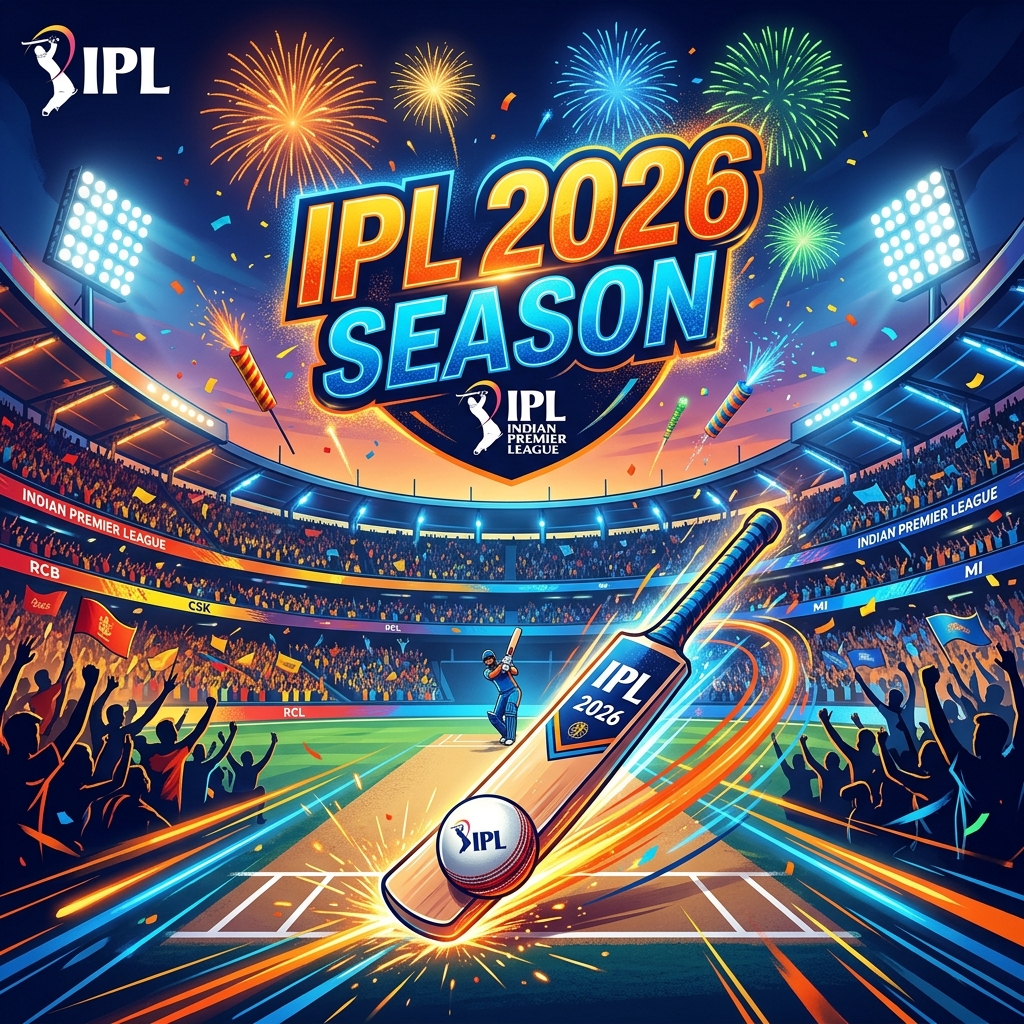
Every year around this time, India collectively decides that sleep is optional, office productivity is negotiable, and the only thing that really matters is whether your team won last night. The Indian Premier League is not merely a cricket tournament—it is the annual cultural event that unites a country of 1.4 billion people across every conceivable demographic divide. CEOs and autorickshaw drivers both refresh Cricbuzz. College students and retired grandparents both argue about batting lineups. IPL 2026 has arrived, and within the first weekend, it has already delivered everything the tournament reliably produces: spectacular batting, controversial umpiring decisions, surprise results, social media meltdowns, and the uniquely Indian experience of caring intensely about a cricket franchise that didn't exist twenty years ago.
IPL 2026 marks the tournament's 19th season—a fact that is simultaneously unremarkable and astonishing. Unremarkable because the IPL feels like it has always existed, so deeply embedded in Indian cultural consciousness that imagining an Indian March-May without it requires genuine cognitive effort. Astonishing because the tournament's transformation from a controversial, disruptive experiment (when it launched in 2008 against significant opposition from cricket traditionalists) into arguably the most commercially successful, most-watched, and most culturally significant domestic sporting league on Earth has happened within a single generation. The IPL's annual revenue now exceeds $1.5 billion across broadcast rights, sponsorships, gate receipts, and merchandise. The media rights deal—sold to JioCinema (digital) and Star Sports (television)—is worth approximately $6.2 billion for a five-year cycle, making it the most expensive domestic sporting broadcast property in the world after the NFL and English Premier League.
IPL 2026 Season Format and Key Changes

The 2026 season retains the ten-team structure introduced in 2022: Chennai Super Kings, Mumbai Indians, Royal Challengers Bengaluru, Kolkata Knight Riders, Delhi Capitals, Rajasthan Royals, Punjab Kings, Sunrisers Hyderabad, Gujarat Titans, and Lucknow Super Giants. Each team plays 14 league-stage matches (seven home, seven away), followed by a playoff structure comprising Qualifier 1, Eliminator, Qualifier 2, and the Final. The total league stage comprises 70 matches played over approximately eight weeks, making it one of the most compressed, high-intensity cricket schedules in the world.
The 2025 mega auction—the triennial player auction where all franchises rebuild their squads with a refreshed salary cap—has created squad compositions that fundamentally alter the competitive landscape. The retention rules allowed each franchise to retain up to six players (with maximum three Indian and three overseas retentions), creating a strategic calculation where franchises had to decide which players were genuinely indispensable and which could be released back into the auction pool. The resulting player movements—some voluntary, some forced by auction dynamics—have produced squad compositions that defy the previous season's hierarchy.
The salary cap for IPL 2026 stands at ₹120 crore per squad—a figure that seems astronomical until you consider that individual player retention costs for the marquee stars consume 30-40% of the total cap. MS Dhoni's retention by Chennai Super Kings (regardless of on-field impact, his commercial and emotional value to the franchise is incalculable), Virat Kohli's continued tenure at RCB, and Rohit Sharma's presence at Mumbai Indians represent franchise-defining relationships that transcend pure cricketing value. These players' retention costs must be balanced against the need to build a competitive eleven with the remaining budget—a constraint that produces the IPL's most fascinating strategic tension: the interplay between cricketing merit, commercial value, and financial constraint.
Opening Weekend: What We Learned
The opening weekend of IPL 2026 has already provided data points that will shape the tournament narrative for the remaining seven weeks. Several observations from the first matches merit serious analysis beyond the immediate excitement of results:
Impact Player Rule Evolution: The Impact Player rule—which allows teams to substitute one player from their playing XI after the toss, effectively creating a 12-member squad—continues to generate tactical complexity that enriches the tournament's strategic depth while simultaneously raising legitimate concerns about its effect on all-rounder development. The rule incentivizes extreme specialization: teams can select five specialist batters and six specialist bowlers (or vice versa), using the impact substitution to replace a batter with a bowler (or vice versa) after determining the match situation. This reduces the premium on genuine all-rounders—players who contribute meaningfully with both bat and ball—because their dual capability is less valuable when specialization can be achieved through substitution. The counterargument is that the rule produces more entertaining, higher-scoring matches by allowing teams to deploy maximum batting or bowling firepower depending on the situation.
Pace Bowling Depth: Indian pace bowling depth—historically the IPL's weakest domestic talent category—appears to have reached a qualitative inflection point. The current generation of young Indian fast bowlers brings genuine pace (140+ km/h consistently), sophisticated variations (slower balls, cutters, bouncers at pace), and physical durability that previous generations lacked. This development has been catalyzed by the IPL's own investment in talent identification: franchise academies, scouting networks that extend into district and club cricket, and the financial incentive structure that makes fast bowling—once a physically demanding, financially unrewarding career path in Indian cricket—genuinely lucrative.
Overseas Recruitment Patterns: The overseas player composition of IPL 2026 squads reveals shifting global power dynamics in T20 cricket. English white-ball specialists—developed through The Hundred and English domestic T20—command premium IPL valuations, while Australian representation has shifted from established Test players (who historically treated the IPL as a pre-Ashes conditioning exercise) to dedicated T20 specialists who treat the IPL as the pinnacle of their playing calendar. The increasing presence of players from associate cricket nations—Namibia, USA, Nepal, Netherlands—reflects the IPL's function as a global cricket development accelerator, providing associate-nation players with exposure to elite competition, access to world-class coaching, and financial remuneration that transforms their professional cricket viability.
The Business of IPL: Beyond Cricket
Understanding the IPL requires understanding that it is, simultaneously and inseparably, a sporting competition and a business enterprise. Each franchise is a private commercial entity—owned by industrial conglomerates, individual billionaires, or private equity consortiums—that generates revenue through multiple streams: a share of the centrally negotiated broadcast rights (the largest revenue component), match-day gate receipts and hospitality sales, team sponsorships and jersey branding, merchandise licensing, and increasingly, franchise-owned media content and digital engagement platforms.
Franchise valuations have grown at rates that exceed most conventional asset classes. Mumbai Indians—the most valuable IPL franchise—is valued at approximately $1.3 billion. Chennai Super Kings, Royal Challengers Bengaluru, and Kolkata Knight Riders carry valuations exceeding $1 billion each. The most recent franchise additions—Gujarat Titans and Lucknow Super Giants—were acquired in 2021 for approximately $700 million and $900 million respectively, reflecting the market's assessment of the IPL's long-term growth trajectory. These valuations are driven not by current profitability (several franchises operate near break-even or at modest levels) but by the expectation that the IPL's broadcast rights value, sponsorship revenue, and commercial ecosystem will continue growing as India's economy expands, digital consumption increases, and the tournament's global footprint widens.
The broadcast and streaming dynamics of IPL 2026 represent the tournament's most significant off-field development. The dual rights model—JioCinema streaming all matches digitally for free (ad-supported) while Star Sports broadcasts on linear television through paid subscription—has created a competitive tension that reflects broader media industry upheaval. JioCinema's free streaming strategy has dramatically expanded the IPL's viewership base, with individual match peak concurrent streams exceeding 30 million—numbers that make the IPL one of the most-streamed live events globally. The question of whether free digital streaming enhances or cannibalizes the value of paid television broadcast rights is the media industry's most consequential ongoing experiment, and the IPL is its largest laboratory.
Fan Culture: The Emotional Economy
The IPL has created an emotional economy that operates independently of—and often in contradiction to—rational sporting analysis. The loyalty dynamics of IPL fandom are fundamentally different from traditional cricket allegiance (which follows national teams) and from Western club sport allegiance (which typically follows geographic proximity). IPL fandom is tribal, identity-based, and often irrationally intense—a Chennai Super Kings fan in Delhi will support CSK with a passion that mirrors geographic tribalism without being geographically anchored. This delocalized, personality-driven fandom—where fans follow MS Dhoni rather than Chennai, or Virat Kohli rather than Bengaluru—creates unique commercial dynamics: player brand value exceeds franchise brand value for the most iconic individuals, and player transfers or retirements can fundamentally alter a franchise's commercial viability.
The social media dimension of IPL fandom has evolved from commentary to content ecosystem. Every match generates not just live viewing but a parallel universe of memes, hot takes, tactical analyses, player compilations, and controversy dissections that extend the tournament's cultural footprint far beyond the three-hour match window. A controversial DRS decision at 9 PM becomes a Twitter trending topic by 9:02 PM, generates 10,000 memes by 9:30 PM, enters mainstream news coverage by 10 PM, and is the subject of a YouTube analysis video with 2 million views by the next morning. The IPL doesn't just occupy three hours of screen time per match day; it occupies the entire cultural conversation for two months.
Frequently Asked Questions (FAQs)
Which team is the favourite to win IPL 2026?
Predicting IPL champions based on squad composition is notoriously unreliable—the tournament's history is littered with expensively assembled squads that underperformed and underdog teams that exceeded expectations. That said, the teams with the most balanced combinations of batting depth, bowling variety, domestic talent, and experienced leadership include Mumbai Indians, Chennai Super Kings, and Kolkata Knight Riders. The emerging challengers—Rajasthan Royals and Gujarat Titans—have squad constructions emphasizing young Indian talent and smart tactical recruitment that could produce deep playoff runs. The honest answer is that in a T20 tournament with 70 league matches, enough variance exists that any team capable of stringing together three or four consecutive wins can transform a mediocre start into a playoff berth.
Is the IPL bad for Indian cricket?
This question has persisted since the IPL's inception and the answer has evolved from "possibly" to "definitively no." The IPL has demonstrably improved Indian cricket by: exposing young Indian players to high-pressure competition alongside international stars (the confidence a 22-year-old Indian bowler gains from dismissing a World Cup-winning batter is transformative); creating financial incentives that have made cricket a viable full-time profession for hundreds of players who would otherwise have abandoned the sport for economic reasons; investing in grassroots development through franchise academies; and developing tactical sophistication (field placements, matchup-based bowling changes, batting tempo management) that India's national team has directly benefited from. The legitimate concerns—Test cricket scheduling disruptions, player burnout, the potential prioritization of IPL contracts over national team commitments—are real but manageable, and have been progressively addressed through BCCI scheduling reforms.
How can I watch IPL 2026 for free?
JioCinema streams every IPL match live and for free on its app and website—no subscription required. You can watch on any device (smartphone, tablet, laptop, smart TV) with an internet connection. The free stream includes multiple camera angles, real-time statistics, and Hindi/English commentary options. JioCinema's free IPL streaming is ad-supported, meaning you will see advertising interruptions during strategic breaks, but the core match coverage is identical to the paid broadcast. Star Sports offers the traditional television broadcast through paid DTH and cable subscriptions, with additional features like pre-match analysis shows, expert commentary panels, and studio discussions that the free digital stream does not include.


Comments (0)
Be the first to share your thoughts on this article.