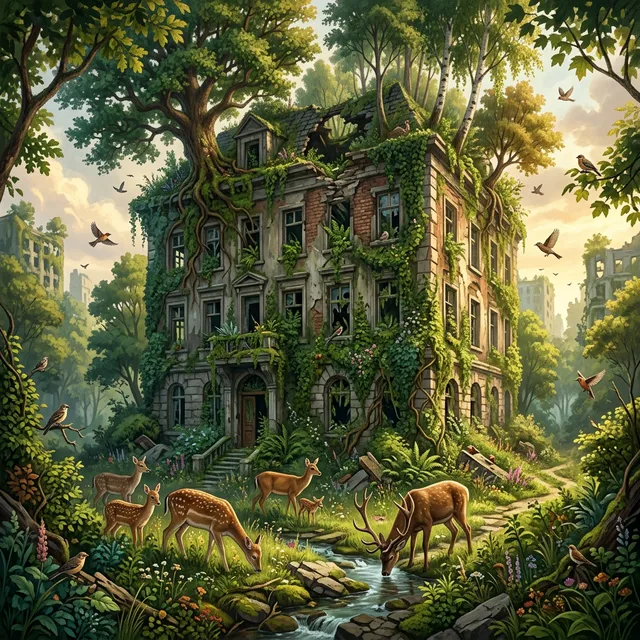
In the spaces between human activity—the cracks in pavement, the margins of railways, the rooftops of abandoned buildings, the banks of urban rivers—a quiet revolution is taking place. Nature is returning to cities, not through human intention but through human neglect, and the results are producing some of the most interesting ecological and philosophical questions of our era. Rewilding—the practice of restoring ecosystems to their natural state by removing human management and allowing ecological processes to resume—has traditionally been a rural and wilderness concept: reintroducing wolves to Yellowstone, allowing farmland to revert to forest, restoring wetlands that had been drained for agriculture. But the most surprising and, in some ways, most consequential rewilding is happening in places where nobody planned it: in cities.
Urban rewilding—both accidental (nature reclaiming abandoned human infrastructure) and deliberate (cities actively creating wild spaces within their boundaries)—is challenging the fundamental assumption that cities and nature are opposites. They are not. Cities are ecosystems—artificial, highly modified, human-dominated ecosystems, but ecosystems nonetheless, with food webs, nutrient cycles, territorial species, and ecological niches. The question is not whether nature exists in cities (it does, everywhere, always) but whether cities will allow nature to express itself more fully, and what happens—ecologically, aesthetically, psychologically, economically—when they do.
The Accidental Rewilding: What Happens When Humans Leave

The most dramatic examples of urban rewilding are accidental—the result of economic decline, industrial abandonment, or catastrophic events that caused humans to vacate urban areas. Detroit, which lost over 60% of its population between 1950 and 2020, contains an estimated 40 square miles of vacant land—former residential lots, industrial sites, and commercial properties that have been reclaimed by a succession of pioneer plants (grasses, ragweed, goldenrod), followed by shrubs and small trees (sumac, mulberry, ailanthus), producing urban meadows and young forests within neighborhoods that contained houses within living memory. The ecological community that has developed on Detroit's vacant lots includes species diversity that exceeds many intentionally managed urban parks, because the absence of human management allows the full succession process to unfold without the mowing, herbiciding, and "cleanup" that parks departments impose.
Chernobyl's exclusion zone—the 2,600 square kilometre area evacuated after the 1986 nuclear disaster—represents the most extreme example: 38 years without human habitation have produced a thriving ecosystem that includes wolves, lynx, European bison, Przewalski's horses, and over 200 bird species. The zone is not pristine—the ecological community exists despite ongoing radiation contamination—but it demonstrates a counterintuitive truth: the ecological impact of human presence (habitat destruction, pollution, fragmentation) is, for most species, more harmful than low-level radiation exposure. Nature's tolerance for radiation exceeds its tolerance for us.
Deliberate Urban Rewilding: Cities That Are Choosing Nature
The more interesting—and more replicable—story is deliberate urban rewilding: cities that are actively choosing to convert managed, maintained urban spaces into wilder, more ecologically complex environments. Singapore's transformation from a concrete-dominated tropical city into a "city in a garden" is the most ambitious: the city-state has integrated nature into its urban fabric through mandatory green roof requirements for new developments, the Supertree Grove at Gardens by the Bay (vertical gardens that function as biodiversity habitats and rainwater collectors), urban corridors connecting parks and nature reserves to allow wildlife movement across the city, and the restoration of its waterways (the Bishan-Ang Mo Kio Park transformed a concrete drainage channel into a naturalised river with meandering banks, native vegetation, and wildlife habitat).
In India, the urban rewilding conversation is nascent but growing. Mumbai's Aarey Forest—a 1,300-hectare green space within the city limits that contains leopards, over 170 bird species, and several tribal communities—represents both the opportunity and the conflict inherent in urban rewilding: the forest is ecologically invaluable and is under perpetual development pressure from infrastructure projects. Chennai's restoration of its traditional water management systems—the temple tanks, lakes, and channels that historically managed the city's water cycle—represents a form of urban rewilding that reconnects the city with its pre-modern ecological infrastructure, providing flood management, groundwater recharge, and habitat in a city that has suffered devastating floods partly because those traditional systems were filled and built over.
The Ecological Benefits: Why It Actually Works
Urban rewilding produces measurable ecological benefits that extend well beyond aesthetics. Urban heat island mitigation: green spaces reduce ambient temperatures by 2-8°C compared to surrounding built-up areas through evapotranspiration and shading, directly reducing cooling energy demand and heat-related health impacts in surrounding buildings and streets. Stormwater management: natural and semi-natural landscapes absorb and filter rainfall that would otherwise flow directly into drainage systems, reducing flood risk and reducing the pollutant load entering urban waterways. Biodiversity support: even small patches of urban wilderness (500 square metres or more) can support insect communities, bird populations, and small mammal species that are absent from manicured parks and gardens—contributing to urban pollination (essential for urban agriculture and garden productivity), pest control, and the general ecological health of the urban ecosystem.
Air quality improvement: urban vegetation filters particulate matter, absorbs gaseous pollutants (nitrogen dioxide, sulphur dioxide, ground-level ozone), and produces oxygen. A mature urban tree removes approximately 20-50 kg of pollutants from the air annually. A dense urban tree canopy over a neighbourhood can reduce particulate matter concentrations by 10-20%—a meaningful health intervention in Indian cities where air quality regularly exceeds WHO safety thresholds by factors of 5-10x. Mental health benefits: exposure to natural environments—even small, urban natural spaces—reduces cortisol levels, blood pressure, and self-reported stress. The Japanese concept of shinrin-yoku (forest bathing) has been validated in urban contexts: 20 minutes in a urban green space produces measurable physiological stress reduction.
Frequently Asked Questions (FAQs)
Is urban rewilding practical in dense Indian cities?
Yes, though the scale and form must be adapted to Indian urban realities. Full wilderness restoration is impractical in cities with population densities of 20,000+ people per square kilometre—but micro-rewilding interventions are feasible and valuable: converting unused lots to native meadows rather than manicured lawns, planting native tree species along streets and in parks, restoring urban water bodies (tanks, lakes, channels) with native riparian vegetation, creating green roofs and walls on government and commercial buildings, and establishing wildlife corridors along rivers, rail lines, and utility easements. The collective impact of thousands of small interventions across a city can be ecologically significant—Singapore demonstrates this at national scale, but even individual neighbourhood interventions produce measurable local benefits.
Won't wild urban spaces attract pests and create safety concerns?
This is the most common objection, and it conflates "wild" with "neglected." Well-designed urban rewilding creates biodiverse ecosystems, not garbage dumps. Managed wildness—native plantings that are allowed to grow naturally but are periodically maintained to prevent invasive species dominance, remove litter, and maintain sightlines for personal safety—is distinct from abandonment. Ecologically diverse spaces actually reduce pest problems compared to monoculture landscapes: the predator-prey relationships in a diverse ecosystem provide natural pest control that manicured lawns and ornamental plantings do not. Safety concerns are addressed through design: clear sightlines, adequate lighting at entry points, maintained pathways through wild areas, and community engagement that creates social surveillance and shared stewardship.
How can I contribute to urban rewilding in my neighbourhood?
Start with your own outdoor space—balcony, terrace, garden, or window box. Plant native species rather than ornamentals (native plants support 10-50x more insect species than non-native ornamentals, providing the base of the urban food web). Reduce or eliminate lawn area (lawns are ecological deserts—low-diversity, high-maintenance, chemically dependent monocultures that provide almost no habitat value). If you have a garden, leave a portion unmowed and unmanaged—even a 2x2 metre patch of "messy" garden, allowed to grow wild with native grasses and wildflowers, provides habitat for insects, ground-nesting birds, and small mammals. Advocate for native planting and reduced chemical management in your residential society, your workplace grounds, and your local parks. The aggregate effect of thousands of individual decisions to tolerate—and even celebrate—wildness in urban spaces is the foundation of urban rewilding.
The Future of Urban Rewilding
Urban rewilding is not a return to some imagined pre-urban paradise—it is a forward-looking integration of ecological thinking into urban design that acknowledges cities as permanent human habitats and seeks to make them healthier, more resilient, and more beautiful. The cities that are leading this integration—Singapore, Melbourne, Copenhagen, and a growing number of Indian cities including Bangalore, Chennai, and Pune—are demonstrating that urban density and ecological richness are not contradictory goals. Green infrastructure—living roofs, bioswales, urban wetlands, pocket forests, wildlife corridors along rivers and railways—can be integrated into urban development without reducing buildable area or compromising economic productivity. The evidence is growing that these integrations increase property values, reduce healthcare costs, improve worker productivity, and enhance the overall quality of urban life in ways that justify their implementation costs several times over.
The philosophical shift underlying urban rewilding is perhaps more important than any specific intervention: the recognition that humans are not separate from nature but embedded within it, and that cities—as human habitats—function better when they accommodate the ecological relationships that sustain all life. The concrete box of the twentieth-century city was an experiment in environmental exclusion. The twenty-first-century city is rediscovering that life thrives not in exclusion but in integration.

Comments (0)
Be the first to share your thoughts on this article.