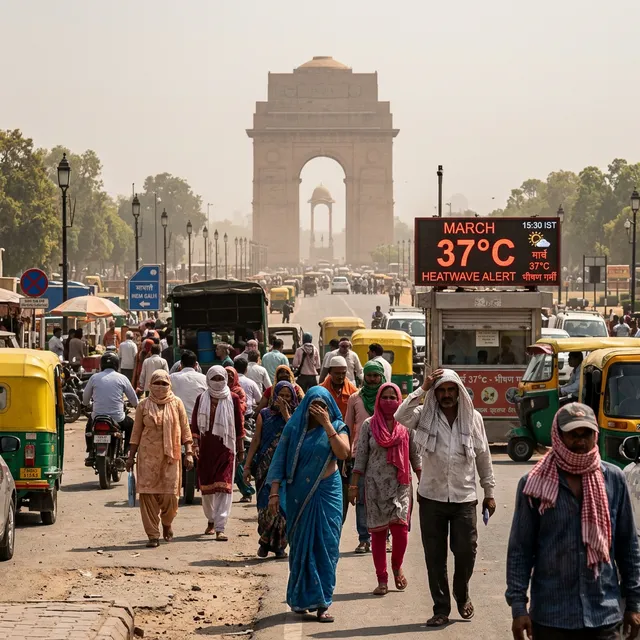
It is March 15, 2026, and the thermometer at Palam weather station in Delhi reads 40.2°C. This is not a typing error. This is not an anomaly. This is the new normal—a temperature reading that would have been considered an extreme May measurement twenty years ago, now arriving in mid-March. The mango trees are blooming a month early. The wheat fields in Haryana—weeks away from harvest—are showing signs of terminal heat stress, their grain development arrested by temperatures that exceed the crop's biological tolerance threshold precisely during the critical reproductive phase. The municipal water supply in several Rajasthan cities has been rationed since February. And the summer has not even technically begun.
India has always been a hot country. Indians have always endured intense summers. These facts are historically undeniable and strategically irrelevant to the current crisis, because what India is experiencing in 2026 is not its traditional summer—it is its traditional summer superimposed upon a baseline temperature increase driven by global climate change, amplified by the urban heat island effect in its rapidly growing cities, and arriving earlier, lasting longer, and reaching peaks that human physiology is not designed to survive for extended periods. The 2026 heatwave season is not just uncomfortable; it is, for hundreds of millions of working Indians, genuinely dangerous.
The Numbers Behind the Heat: Why 2026 Feels Different

India's average surface temperature has increased by approximately 0.7°C since 1901, per the India Meteorological Department's long-term records. This number sounds modest. It is anything but. Temperature averages obscure the extremes, and it is the extremes that kill. What a 0.7°C average increase translates to, in practice, is that the frequency of extreme heat events—days exceeding 45°C in northern India and 40°C in coastal and peninsular India—has roughly doubled over the past three decades. The heatwave season, which historically occupied a six-to-eight-week window from late April through May, now effectively extends from mid-March through mid-June—a nearly ninety-day window of extreme thermal stress.
The India Meteorological Department documented over 200 heatwave days across monitoring stations in 2025—the highest number ever recorded. Climate models project that by 2040, large parts of northern India will regularly experience "wet-bulb temperatures"—a combined measure of heat and humidity—that exceed 35°C, which represents the absolute limit of human thermoregulation. At wet-bulb temperatures above 35°C, a healthy, fit, young adult sitting motionless in the shade will die of heat stroke within approximately six hours because the human body's evaporative cooling mechanism (sweating) ceases to function. This is not a theoretical projection; it is a thermodynamic boundary condition that no amount of acclimatization, fitness, or willpower can override.
The Labour Crisis: When Work Becomes Physically Lethal
India's extraordinary vulnerability to extreme heat is not primarily a meteorological fact; it is a structural, economic fact. Over 50% of India's workforce—approximately 500 million people—is employed in agriculture, construction, manufacturing, street vending, transportation, and other occupations that require prolonged outdoor or semi-outdoor physical labour during peak temperature hours. These workers do not have the option of retreating to air-conditioned offices during a 46°C afternoon. They do not have flexible work-from-home arrangements. They work in the heat—carrying bricks, harvesting wheat, driving auto-rickshaws, operating roadside food stalls—or they do not earn income. For India's 200-million-strong daily wage labour force, a lethal heatwave is not an "weather event"; it is an economic catastrophe that simultaneously threatens their physical survival and their financial survival.
A 2023 study published in the Lancet Planetary Health estimated that India lost approximately 167 billion potential labour hours in 2022 due to occupational heat exposure—the highest of any country on Earth, by a massive margin. One hundred sixty-seven billion hours. This number translates directly into trillions of rupees in lost economic output and, more importantly, into millions of individual workers whose daily earnings were reduced because they literally could not physically continue working in the heat. A construction labourer in Nagpur earning ₹500 per day who is forced to stop work for three hours during afternoon peak heat has effectively taken a 30-40% pay cut—not by choice, not by employer decision, but by the laws of thermodynamics operating on human physiology.
Urban Heat Islands: Cities That Cook Their Inhabitants
India's rapid, often unplanned urbanization has created a heat amplification phenomenon that dramatically worsens the climate-driven temperature increase. The urban heat island effect—the measurable temperature differential between densely built urban areas and surrounding rural regions—adds 3-7°C to ambient temperatures in Indian cities. This means that when the IMD weather station at Delhi's Safdarjung records 43°C, the actual thermal experience at street level in densely packed neighbourhoods like Chandni Chowk, Karol Bagh, or Trilokpuri is 46-50°C.
The physics is brutally straightforward. Concrete and asphalt absorb solar radiation throughout the day and re-emit it as heat throughout the night, preventing the nocturnal cooling that would provide physiological recovery. Dark-coloured rooftops absorb more heat than they reflect. Narrow, canyon-like streets between closely spaced buildings trap hot air and restrict ventilation. The near-total absence of urban tree canopy in most Indian commercial and residential areas eliminates the evapotranspiration cooling effect that vegetation provides. Air conditioning units—increasingly prevalent in middle-class Indian homes—exhaust hot air directly into the street, further elevating ambient outdoor temperatures in a vicious positive feedback loop: the hotter it gets outside, the more AC runs indoors, the more waste heat is pumped outside, the hotter it gets outside.
The people most severely affected by the urban heat island—residents of dense, low-income neighbourhoods with minimal ventilation, no green space, no air conditioning, corrugated metal or asbestos roofing that converts sunlight directly into interior heat, and limited access to clean water for hydration and bathing—are precisely the people least visible in policy discussions, least politically powerful, and least able to afford the private adaptations (AC, bottled water, flexible employment) that middle-class heat discourse implicitly assumes.
The Silent Health Crisis: Heat Deaths India Doesn't Count
Heat-related mortality in India is systematically, dramatically underreported. The fundamental diagnostic challenge is that extreme heat kills indirectly: it triggers cardiac arrest in people with pre-existing cardiovascular disease, it causes acute kidney failure in dehydrated workers, it precipitates fatal strokes, it escalates heatstroke into multi-organ failure. Death certificates record the immediate cause of death—"cardiac arrest," "renal failure," "cerebrovascular accident"—not the underlying cause (prolonged heat exposure). Epidemiological estimates, using excess mortality analysis (comparing death rates during heatwave periods against baseline mortality rates), suggest that heat-attributable deaths in India number in the thousands annually—potentially 5,000-10,000 per year—with the vast majority occurring among outdoor workers, the elderly, and urban poor populations.
The less-discussed but potentially more devastating long-term health impact is chronic kidney disease (CKD) among agricultural workers. Repeated episodes of dehydration during prolonged heat exposure cause cumulative, progressive kidney damage that is not immediately symptomatic but eventually produces irreversible renal failure. Epidemiological studies in Central American sugarcane-cutting communities documented epidemic levels of CKD among young, otherwise healthy workers—a phenomenon researchers termed "Mesoamerican nephropathy." Emerging evidence suggests analogous patterns in Indian agricultural regions, particularly among sugarcane workers in Maharashtra and Uttar Pradesh and rice paddy workers in Andhra Pradesh, though comprehensive Indian epidemiological studies remain tragically limited.
Adaptation: What Works, What Doesn't, What's Missing
India's National Disaster Management Authority coordinates heat action plans for vulnerable states and cities. Ahmedabad's Heat Action Plan—the first in South Asia, developed after a devastating 2010 heatwave that killed over 1,300 people in the city—has become a globally studied model. The plan includes early warning systems triggered by IMD temperature forecasts, public awareness campaigns in vernacular languages, protocols for opening cooling centres, distribution of oral rehydration solution, and coordination between health departments and emergency services. Modified versions have been replicated across dozens of Indian cities.
But the structural interventions that would meaningfully reduce urban heat exposure—the interventions that address causes rather than symptoms—remain dramatically underimplemented. Cool roof programs (coating building rooftops with reflective white paint that reduces indoor temperatures by 2-5°C at a material cost of ₹20-30 per square foot) have been piloted in Ahmedabad, Hyderabad, and Jodhpur with documented, dramatic results, yet have not been mandated through building codes at scale. Urban greening initiatives that could meaningfully reduce the heat island effect require planting millions of trees and dedicating significant urban space to green infrastructure. Modified work-hour policies for outdoor labourers during extreme heat events—shifting construction and agricultural work to early morning and late evening hours—have been recommended but are rarely enforced because they conflict with project timelines, contractor economics, and worker preferences for concentrated work schedules.
Frequently Asked Questions (FAQs)
Is climate change the only cause of India's intensifying heatwaves?
No. India's heatwave intensification results from three converging factors: global climate change (raising baseline temperatures), rapid urbanization (the heat island effect adding 3-7°C in cities), and land-use change (deforestation and concrete expansion reducing natural cooling mechanisms). Climate change is the most important single factor, but urban planning decisions and land management practices significantly amplify its impact. A city designed with abundant tree canopy, reflective surfaces, ventilated building layouts, and water features would experience the same climate-driven temperature increase with substantially less lethal consequences.
Why doesn't India just install more air conditioning?
India currently has approximately 8-10% household air conditioning penetration (compared to 90%+ in the United States and Japan). Increasing AC adoption is happening rapidly—India is the world's fastest-growing AC market—but universal air conditioning faces three severe structural constraints. First, India's electricity grid cannot currently support universal AC load during peak demand; residential peak-hour demand already causes brownouts and load shedding in many cities. Second, conventional AC is enormously energy-intensive, and powering universal AC with coal-generated electricity would massively increase carbon emissions, accelerating the very climate change that is driving the heat. Third, AC is economically inaccessible to the populations most vulnerable to heat—the urban poor, daily wage labourers, and rural communities who constitute the majority of heat-related casualties.
What can an individual Indian household do to reduce indoor heat?
The most cost-effective intervention is a cool roof—applying solar-reflective white coating to the building rooftop, which typically reduces indoor temperatures by 2-5°C at a one-time material cost of ₹1,000-3,000 for a typical home. Cross-ventilation (ensuring windows or openings on opposite walls allow air to flow through the structure) is free and significantly improves thermal comfort. Exterior shading—growing climbing plants on sun-facing walls, installing bamboo screens or fabric awnings over windows—reduces solar heat gain. Avoiding cooking during peak afternoon hours (using pressure cookers for faster cooking during morning hours) reduces indoor heat generation. These measures do not eliminate discomfort during extreme heat events but meaningfully reduce indoor temperatures at negligible or zero cost.


Comments (0)
Be the first to share your thoughts on this article.