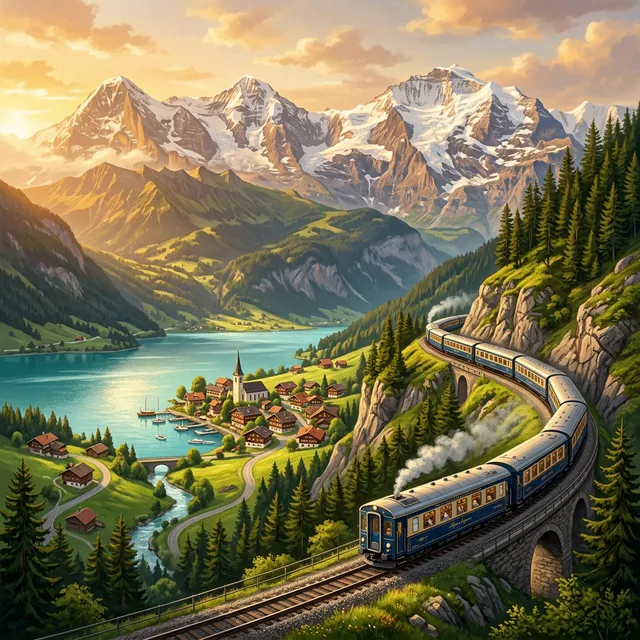
There is a specific category of luxury that has nothing to do with thread counts, infinity pools, or Michelin-starred restaurants. It is the luxury of slowness—of moving through a landscape at a speed that allows you to actually see it, of watching geography change gradually through a window rather than disappearing beneath a cloud layer at 35,000 feet, of arriving at your destination having experienced the journey as a continuous, connected narrative rather than a discontinuous leap from departure gate to arrival carousel. Train travel offers this luxury, and in 2026, the world is going through a remarkable renaissance in luxury rail that would have seemed impossible a decade ago, when high-speed rail and budget airlines appeared to have permanently consigned long-distance trains to the category of nostalgia.
The resurgence is driven by two converging forces: environmental consciousness (trains emit 75-90% less CO₂ per passenger-kilometre than aviation, and a growing segment of travelers weighs carbon impact in their transport choices) and the experiential economy (travelers who have optimised the destination experience—luxury hotels, curated activities, gourmet dining—are discovering that the journey between destinations can be equally rich, and that a 30-hour train journey is not dead time to be endured but living time to be enjoyed). The result is a global expansion of luxury, heritage, and scenic rail services that cater to travelers who have decided that getting there is not merely a logistical necessity but an integral part of the travel experience.
India: The Maharajas' Express and Beyond

India operates some of the world's most distinctive luxury trains, and their existence is a peculiar miracle of commercial hospitality: fully functioning five-star hotels that navigate the Indian railway network's 68,000 kilometres of track, serving multi-course dinners in dining cars while the landscape of Rajasthan or the Deccan Plateau scrolls past windows that haven't been cleaned as recently as you'd prefer but frame views that no hotel window can match.
The Maharajas' Express, operated by IRCTC, is the most opulent: seven-day journeys through Rajasthan, Gujarat, and Uttar Pradesh, with fixed itineraries that include off-train excursions to the Taj Mahal, Ranthambore National Park, Jaipur's Amber Fort, and Udaipur's City Palace. The train itself features cabins finished in period-appropriate Rajputana décor (carved wood panels, brass fittings, silk upholstery), a bar car serving Indian and international wines and spirits, a dining car offering multi-course Indian and continental menus, and an observation lounge with panoramic windows designed for the specific purpose of watching India go by. Prices range from approximately ₹4-8 lakh per person for the complete journey including all meals, excursions, and accommodation—a figure that is extravagant by any standard and that represents genuine value when calculated against the alternative cost of seven days of comparable five-star hotel accommodation, guided excursions, private transportation, and meals at equivalent quality levels.
The Palace on Wheels offers a similar experience at a moderately lower price point, with seven-day Rajasthan circuits that have been operating since 1982—making it one of the world's longest-running luxury train services. The Golden Chariot covers South India (Bangalore to Goa, via Hampi, Mysore, and Hassan), providing access to a region whose architectural and natural heritage is equal to Rajasthan's but receives a fraction of the international tourist attention.
For travelers who want the train experience without the luxury price tag, India's Vande Bharat Express network—India's semi-high-speed train service, expanding to cover most major routes by 2026—offers an experience that is not luxurious but is comfortable, scenic, and dramatically superior to both domestic flights (which offer nothing except speed) and conventional trains (which offer everything except comfort and punctuality). The Delhi-Varanasi Vande Bharat, the Mumbai-Goa Vande Bharat, and the Chennai-Mysore Vande Bharat are particularly recommended for scenic value.
Europe: The Orient Express Lives Again
The Venice Simplon-Orient-Express—the legendary train that inspired Agatha Christie's murder mystery and whose name is synonymous with the golden age of rail travel—continues to operate between London (via the Channel Tunnel) and Venice, with seasonal extensions to Paris, Prague, Vienna, and Istanbul. The experience is deliberately, unapologetically anachronistic: 1920s and 1930s restored carriages with marquetry panels, art deco fixtures, and individual sleeping compartments that are smaller than a modern hotel bathroom but infinitely more romantic. Formal dress is expected for dinner. A three-course French menu is served in a dining car that would not be out of place in a period film. The journey from London to Venice takes approximately 24 hours and costs approximately €3,000-10,000 per person depending on cabin class and season.
The European overnight sleeper network—which nearly disappeared in the 2010s as budget airlines undercut train pricing—has been revived by environmental consciousness and by the Austrian company Nightjet, which now operates overnight sleeper services connecting Vienna, Munich, Zurich, Rome, Milan, Brussels, Amsterdam, Paris, and Barcelona. A private sleeping compartment on a Nightjet train from Vienna to Rome costs approximately €100-200—comparable to a budget hotel night plus a flight, but with zero airport security queues, no 5 AM alarm for a morning flight, and the specific pleasure of falling asleep in one country and waking up in another.
Japan: Where Rail Is Religion
Japan's Shinkansen (bullet train) network is not luxury rail in the traditional sense—there are no dining cars, no observation lounges, no uniformed attendants serving champagne. What the Shinkansen offers instead is a form of luxury that is specifically Japanese: the luxury of absolute reliability, absolute cleanliness, absolute efficiency, and the quiet, secular sanctity of a system that works exactly as it should, every time, without fuss. The Shinkansen's punctuality record—average delay of less than one minute across all services—is not merely impressive; it is a philosophical statement about the relationship between a society and its infrastructure.
For tourists, the Japan Rail Pass (approximately ₹25,000-50,000 for 7-21 days of unlimited travel) transforms the Shinkansen network into the world's most efficient sightseeing tool: Tokyo to Kyoto in 2 hours 15 minutes, Kyoto to Hiroshima in 1 hour 40 minutes, Tokyo to the snow country of Niigata in 1 hour 40 minutes—each journey through landscapes that are worth the window-gazing: rice paddies, mountain tunnels, coastal passes, and the iconic views of Mount Fuji from the Tokaido line between Tokyo and Osaka.
The Economics of Slow Travel by Rail
Rail travel's economic equation has shifted significantly in favour of trains over the past three years. Carbon pricing mechanisms (implemented or planned in the EU, UK, and parts of Asia), aviation fuel surcharges, and the increasing cost of airport transfers, checked baggage fees, and pre-flight time costs have narrowed the price gap between trains and flights for many routes. When you include the total journey cost—home to destination, including airport transfers, security wait times, baggage fees, and the productivity loss of the airport experience—train travel is price-competitive with aviation for distances up to 800-1,000 kilometres in Europe and 500-700 kilometres in India, while providing a dramatically superior quality of experience.
Frequently Asked Questions (FAQs)
Are luxury trains worth the price?
This depends entirely on what you value. If you measure vacation value by the number of destinations covered per rupee spent, luxury trains are poor value—you can visit the same destinations for 80-90% less using conventional transport and budget accommodation. If you value the quality of the experience—the texture of each hour, the beauty of the environment, the quality of the food, the romance of the journey—luxury trains are among the highest-value experiences available in travel. The Maharajas' Express journey through Rajasthan is not "visiting Rajasthan by train." It is a self-contained, seven-day experience of extraordinary beauty, comfort, and cultural immersion that happens to include Rajasthan's major sights. Whether that experience is worth ₹4-8 lakh is a personal value judgment, not an objective question.
What's the best luxury train experience for a first-timer?
For Indian travelers: the Palace on Wheels offers the best combination of iconic destinations (Rajasthan), reasonable duration (7 days), and value relative to the Maharajas' Express. For budget-conscious travelers seeking a luxury train taste: the Vande Bharat Executive Class on a scenic route (Mumbai-Goa, Delhi-Varanasi) provides a comfortable, scenic rail experience at approximately ₹2,000-3,000 per journey. For international travelers: the Nightjet sleeper from Vienna to Venice or Rome offers an accessible, affordable entry to overnight rail luxury at €100-200.
Is train travel actually better for the environment than flying?
Yes, substantially. Trains emit approximately 30-50 grams of CO₂ per passenger-kilometre (varying by power source—electric trains powered by renewable energy can approach zero operational emissions). Short-haul flights emit approximately 250-350 grams of CO₂ per passenger-kilometre. For a Delhi-Mumbai journey: train emission is approximately 20-40 kg CO₂; flight emission is approximately 150-200 kg CO₂—a 4-5x difference. For the Paris-London route: Eurostar train emission is approximately 6 kg CO₂; flight emission is approximately 120 kg CO₂—a 20x difference. The environmental case for rail over aviation is unambiguous for any journey where a viable train alternative exists.
Planning Your First Luxury Rail Journey: For first-time luxury rail travellers, the practical advice is: book well in advance (3-6 months for popular routes and seasons), pack light (cabin space on trains is limited compared to hotel rooms, and excessive luggage is the most common source of discomfort), bring entertainment for the sections between scenic highlights (even the most beautiful railway journey includes hours of less-scenic passage through agricultural plains and urban outskirts), and—perhaps most importantly—surrender to the pace. The entire value proposition of luxury rail is slowness, and travellers who spend the journey anxious about how much faster they could have flown have fundamentally misunderstood what they purchased. The journey is the destination. Settle into your compartment, watch the geography change through your window, eat well, sleep to the rhythm of the rails, and arrive having experienced the passage between places rather than merely the places themselves.

Comments (0)
Be the first to share your thoughts on this article.