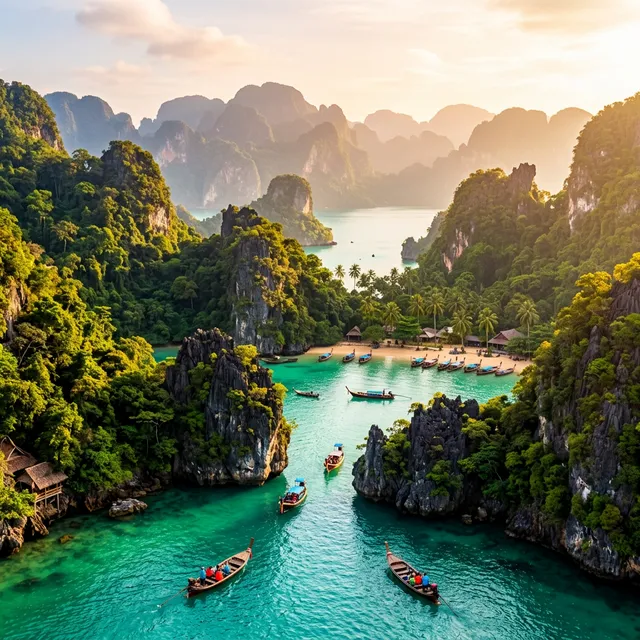
Southeast Asia's most popular destinations—Bali, Phuket, Bangkok, Siem Reap—are popular for excellent reasons: they offer genuine beauty, rich culture, outstanding food, and well-developed tourist infrastructure. They are also, in 2026, characterised by overcrowding that has fundamentally altered the experience of visiting them. Bali's once-photogenic rice terraces are viewed through a crowd of other tourists attempting to photograph the same terraces. Phuket's beaches accommodate more sunbeds than sand. Bangkok's Grand Palace district moves at a pace determined by tour group density rather than individual curiosity. The places are still beautiful, but the experience of visiting them has been degraded by the sheer volume of simultaneous visitors.
This essay is a practical guide to Southeast Asian destinations that offer comparable natural beauty, cultural richness, and food quality at a fraction of the tourist density—destinations that are not "undiscovered" (a word that is both colonialist and factually incorrect—local populations have been living in these places for centuries) but are undervisited relative to their quality, primarily because they lack the marketing momentum, direct flight connections, and Instagram profile of their more famous neighbours.
Luang Prabang, Laos: The City That Time Respects

Luang Prabang—the former royal capital of Laos, a UNESCO World Heritage Site since 1995—is what Chiang Mai was twenty years ago: a small, beautiful, culturally rich city with a manageable tourist presence, outstanding food, and a pace of life that operates at approximately one-third the speed of Bangkok. The city occupies a peninsula at the confluence of the Mekong and Nam Khan rivers, and its architecture combines French colonial buildings (from the Lao kingdom's period as a French protectorate), traditional Lao wooden houses on stilts, and approximately 30 active Buddhist temples whose monks perform a daily dawn alms-giving ceremony (the tak bat) that is one of Southeast Asia's most photogenic and spiritually affecting daily rituals.
The food in Luang Prabang is exceptional and distinctive—Lao cuisine shares ingredients with Thai and Vietnamese cooking but combines them in ways that are uniquely Lao: sticky rice (eaten with hands, rolled into small balls and used to scoop curries and relishes), laap (minced meat or fish salad with fresh herbs, toasted rice powder, and fish sauce), jaew (spicy dipping sauces made from charred chillies, garlic, and fish sauce), and Or Lam (a thick stew of vegetables, herbs, and meat that is Luang Prabang's signature dish). The night market on Sisavangvong Road serves an extraordinary variety of Lao dishes at prices that make Indian street food look expensive: a complete meal—sticky rice, laap, grilled fish, and papaya salad—costs approximately 40,000-60,000 kip (₹200-300).
The Kuang Si Falls—a three-tier limestone waterfall with turquoise mineral-rich pools that cascade through forest 30 kilometres south of the city—is one of Southeast Asia's most beautiful natural sites. Unlike comparable attractions in Thailand or Bali, Kuang Si is not overwhelmed by visitors—you can swim in the pools, hike above the main falls, and spend an afternoon in what feels like a private forest paradise.
Bagan, Myanmar: Two Thousand Temples in Silence
Myanmar's political situation has severely restricted tourism since the 2021 military coup, and discussing Myanmar as a travel destination requires acknowledging this context: the military government benefits from tourism revenue, the population is suffering from political repression and economic crisis, and the ethical questions around visiting are genuine. That said, Bagan—the plain of over 2,000 Buddhist temples built between the 9th and 13th centuries—remains one of the most extraordinary archaeological landscapes on Earth, comparable to Angkor Wat in scale and arguably superior in atmosphere because of its current emptiness.
When international tourism eventually returns to Myanmar at scale (as it will, once political conditions stabilise), Bagan will become one of the world's most visited archaeological sites. In the interim, travelers who choose to visit (a decision that involves ethical considerations beyond the scope of a travel guide) will find a landscape of brick temples and stupas spread across a dusty plain, visible from hot air balloons at sunrise, explorable by electric bicycle during the cooler hours, and experienced in a silence and solitude that would be impossible at comparable sites in more touristically developed countries.
Kep and Kampot, Cambodia: The Coast That Phnom Penh Forgot
While Cambodia's tourism concentrates around Angkor Wat (Siem Reap) and the beaches of Sihanoukville (now dominated by Chinese casino development), the southern coast towns of Kep and Kampot remain remarkably undeveloped and genuinely charming. Kampot—a riverside town known for its pepper plantations (Kampot pepper is considered among the world's finest and carries a geographical indication), French colonial architecture, and relaxed atmosphere—attracts a steady but modest stream of backpackers and long-term travelers who come for the affordable living, the excellent food, and the proximity to Bokor National Park (which contains a fantastically atmospheric abandoned French colonial hill station—a collection of crumbling Art Deco buildings in the mist at 1,000 metres altitude).
Kep, 25 kilometres from Kampot, is famous for one thing: crab. The Kep Crab Market, a collection of waterfront restaurants serving fresh-caught blue swimming crab with Kampot pepper sauce, is one of the great single-dish destinations in Southeast Asian food culture. A plate of Kampot pepper crab with rice and a cold Angkor beer, eaten at a table overhanging the Gulf of Thailand while fishing boats bob in the foreground, costs approximately $5-8 and constitutes a complete and deeply satisfying meal experience that combines exceptional food, beautiful setting, and the particular pleasure of eating a regional speciality at its absolute point of origin.
Nusa Tenggara, Indonesia: Beyond Bali
Indonesia's Lesser Sunda Islands—stretching east from Bali through Lombok, Sumbawa, Flores, and Timor—contain landscapes, cultures, and diving sites that rival or exceed Bali's offerings at a fraction of the tourist density. Flores, in particular, has emerged as one of Southeast Asia's most compelling destinations for adventurous travelers: Komodo National Park (home to the world's only population of Komodo dragons, accessible by multi-day boat trips from Labuan Bajo), the stunning tri-coloured crater lakes of Kelimutu (three adjacent volcanic lakes that change colour independently, producing combinations of turquoise, green, and red that are genuinely surreal), and a network of traditional villages (including Wae Rebo, a cone-shaped thatched village accessible only by a 4-hour hike through mountainous forest) that maintain cultural practices largely unaffected by tourism.
The diving around Flores and the Komodo archipelago is world-class—strong currents bring nutrient-rich water from the deep ocean, supporting coral reef ecosystems of spectacular diversity: manta rays cruise through cleaning stations, reef sharks patrol drop-offs, and the coral diversity exceeds most other dive destinations in the Coral Triangle (the global epicentre of marine biodiversity). A three-day liveaboard dive trip from Labuan Bajo—including Komodo Island landing, multiple dive sites, and full board—costs approximately $300-500, a fraction of comparable diving experiences in the Maldives or the Great Barrier Reef.
Frequently Asked Questions (FAQs)
Are these destinations safe for tourists?
Luang Prabang, Kampot/Kep, and Flores are all considered safe for tourists, with crime rates against visitors that are lower than most major Southeast Asian cities. Myanmar's safety profile is more complex due to the political situation—areas of active conflict (primarily Shan State, Kachin State, and parts of Chin State) should be strictly avoided, while Bagan, Mandalay, and Inle Lake have historically been safe for tourists. Standard Southeast Asian travel precautions apply everywhere: secure valuables, use reputable transportation, be aware of common scams (overcharging, tuk-tuk commission schemes), and avoid isolated areas at night.
How do I get to these places from India?
Luang Prabang: fly to Bangkok (direct flights from major Indian cities, 4-5 hours), then connect to Luang Prabang (Bangkok Airways or Lao Airlines, 2 hours). Kampot/Kep: fly to Phnom Penh (connect through Bangkok or Kuala Lumpur), then 3-hour bus to Kampot. Flores: fly to Bali (direct flights from Delhi, Mumbai, Chennai), then connect to Labuan Bajo (1.5-hour domestic flight on Lion Air or Wings Air). None of these destinations has direct flights from India—all require one connection through a Southeast Asian hub (Bangkok, Kuala Lumpur, or Singapore).
What's the ideal duration for visiting these destinations?
Luang Prabang: 3-4 days (sufficient for the town, Kuang Si Falls, Pak Ou Caves, and multiple temple visits). Kampot/Kep: 3-4 days (Kampot pepper plantation visits, Bokor National Park, Kep Crab Market, and general relaxation). Bagan: 3-4 days (hot air balloon sunrise, temple exploration by e-bike, sunset viewpoints, and nearby Mount Popa day trip). Flores/Komodo: 5-7 days (Labuan Bajo, Komodo boat trip, Kelimutu, Wae Rebo trek, Spider Web Rice Fields). These destinations are slow-travel destinations—their value lies in unhurried exploration, not in checking off sightseeing lists.
Planning Your Underrated Southeast Asia Itinerary
The ideal approach to visiting these destinations is slow travel: rather than hopping between four countries in two weeks, choose one or two destinations and spend sufficient time to engage deeply with the culture, food, and environment. A two-week itinerary might combine Luang Prabang and Northern Laos (7 days: city exploration, Kuang Si Falls, Pak Ou Caves, and a Mekong River slow boat to the Thai border) with Kampot and Kep in Cambodia (5-7 days: pepper plantation tours, Bokor National Park, Kep Crab Market, river kayaking, and the general pleasure of existing in a small Cambodian town without an agenda). This pace allows the kind of unstructured discovery—wandering into a family restaurant because someone beckoned you in, joining a village ceremony because you happened to walk past, spending an entire afternoon reading in a riverside hammock because the setting was too perfect to leave—that fast-paced tourism systematically eliminates and that produces the travel memories you will actually remember twenty years from now.

Comments (0)
Be the first to share your thoughts on this article.