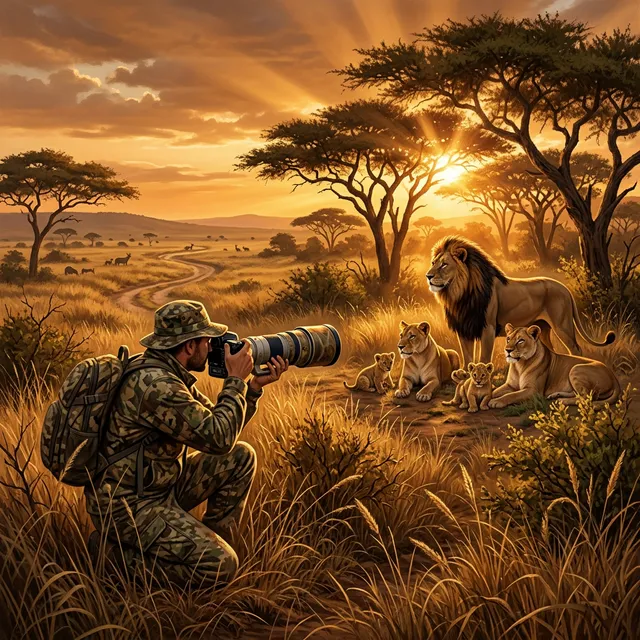
The photograph that changed everything for me was a failure. I had spent six hours in Ranthambore National Park—my first wildlife photography trip, armed with a rented 200-500mm telephoto lens that I barely knew how to use and a determination to photograph a tiger that bordered on pathological. I did not photograph a tiger. I photographed approximately 200 frames of branches that might have concealed a tiger, 50 frames of a langur monkey that I initially mistook for a leopard (the guide was politely silent during my excited whispered commentary), and one extraordinarily sharp, well-composed, technically perfect photograph of an empty clearing where a tiger had been lying three minutes before I arrived. The clearing photograph was beautiful—golden morning light, the impression of a large body in the flattened grass, the stillness of a moment defined by what had just left it. It was also completely useless as wildlife photography, because the wildlife was absent.
That experience taught me the first and most important lesson of wildlife photography, which nobody in the YouTube tutorial ecosystem adequately communicates: the primary skill of wildlife photography is not photography. It is patience. The camera work—exposure, focus, composition—is the easy part, learnable in weeks. The waiting—hours of sitting silently in a hide, in a vehicle, on a riverbank, watching for movement that may not come, maintaining concentration and readiness across dead stretches of inactivity that would bore a monk—is the hard part, learnable only through the accumulation of hours spent doing it, and constituting perhaps 95% of the actual time invested in producing the photographs that the world sees and admires.
Understanding the Animal Before Photographing It

The second lesson, which took longer to learn, was that the quality of wildlife photographs is directly proportional to the photographer's understanding of the animal's behaviour. A photographer who knows that tigers in Ranthambore tend to move toward water sources in the heat of the afternoon will position themselves near water. A photographer who knows that Indian rollers (one of India's most photogenic birds) tend to perch on exposed branches and wires—preferring elevated positions from which they can spot ground-dwelling insects—will scan elevated perches rather than searching the canopy. A photographer who knows that marsh crocodiles bask in early morning sun on specific riverbank locations will arrive before sunrise and be set up when the animal emerges.
This behavioural knowledge comes from three sources: reading (field guides, research papers, and natural history literature specific to your target species), talking to local guides and naturalists (who possess observational knowledge accumulated over years of daily field presence that no book can replicate), and personal observation (spending time watching animals without photographing them, learning their movement patterns, feeding habits, territorial behaviours, and response to human presence). The photographer who arrives at a national park, asks the guide "where are the tigers?", and expects to be driven to a tiger is approaching wildlife photography like a consumer rather than a naturalist—and their photographs, if they get any, will reflect this superficiality.
The Equipment Question (Answered Honestly)
Wildlife photography requires specific equipment, but the entry cost is lower than most people assume and the relationship between equipment cost and image quality is dramatically non-linear above a moderate investment threshold.
Camera body: Any modern DSLR or mirrorless camera with decent autofocus performance and 10+ frames per second burst shooting is adequate. Bodies in the ₹70,000-1,50,000 range (Nikon D7500, Canon EOS R10, Sony a6700) produce professional-quality wildlife images. The marginal improvement from spending ₹3-5 lakh on a professional body (Nikon Z9, Canon R5, Sony a1) is measurable but not transformative—it buys you better autofocus tracking, higher burst rates, and improved low-light performance, but the difference between a good image from a ₹1 lakh camera and a good image from a ₹4 lakh camera is invisible to anyone who is not pixel-peeping at 400% magnification.
Lens: The lens is more important than the body. Wildlife photography requires focal lengths of 400mm or longer for most subjects (except birds at feeders and animals habituated to close human presence). The options span a dramatic price range: the Sigma 150-600mm f/5-6.3 (approximately ₹70,000) produces excellent results and is the entry point I recommend for beginners. The Nikon 200-500mm f/5.6 (approximately ₹90,000) offers slightly better optical quality and a constant f/5.6 aperture throughout the zoom range. The premium options—Nikon 600mm f/4, Canon 600mm f/4, Sony 600mm f/4—cost ₹8-12 lakh and produce optically superior results, but the Sigma 150-600mm at ₹70,000 produces images that are 90% as good at 7% of the price. Start with the Sigma. Upgrade if and when your skill level exceeds the equipment's capability—which, for most photographers, takes years.
India's Wildlife Photography Destinations
Ranthambore National Park, Rajasthan: India's most famous tiger reserve and arguably the best location in the world for tiger photography. Ranthambore's tigers are habituated to tourist vehicles and frequently walk along roads, cross clearings, and rest in proximity to vehicles—enabling photographs at distances of 20-50 metres that would be impossible in less habituated reserves. The best seasons are April-June (when vegetation is sparse and water sources concentrate all wildlife) and October-November (post-monsoon green vegetation provides lush backgrounds). Safari booking (through the official Rajasthan tourism portal) must be done weeks in advance for peak season.
Kaziranga National Park, Assam: The world's best location for one-horned rhinoceros photography. Kaziranga's rhino population (approximately 2,400 individuals—70% of the world's total population) is visible at remarkably close range from elephant-back safaris and jeep safaris. The park also hosts wild water buffalo, Asian elephants, swamp deer, and a significant tiger population. The best season is November-April (the park closes during monsoon, June-October).
Bharatpur (Keoladeo Ghana National Park), Rajasthan: India's premier bird photography destination. The shallow wetlands attract thousands of migratory and resident waterbirds—painted storks, sarus cranes, spoonbills, herons, egrets, cormorants, and (increasingly rarely) Siberian cranes. The accessibility is unmatched: many birds nest within 10-20 metres of the paths and roads that traverse the park, enabling frame-filling photographs with modest telephoto lenses (200-400mm). The best season is October-March, coinciding with the presence of migratory species.
Frequently Asked Questions (FAQs)
Can I get good wildlife photographs with a smartphone?
For most wildlife subjects, no—the focal length limitation of smartphone cameras (equivalent to approximately 24-70mm, even with digital zoom) makes it impossible to fill the frame with a wild animal at typical observation distances. The exception is animals habituated to close human presence: monkeys at temples, birds at urban feeders, deer in parks that allow close approach. For these subjects, modern smartphones (iPhone 15 Pro, Samsung S24 Ultra, Google Pixel 8 Pro) produce genuinely impressive results—their computational photography algorithms compensate for small sensor limitations in ways that would have seemed impossible five years ago. But for serious wildlife photography—filling the frame with a tiger at 50 metres, capturing a kingfisher in flight, photographing a raptor perched in a distant tree—a dedicated camera with a telephoto lens is essential.
How do I start learning wildlife photography?
Start with birds in your local environment—urban parks, lakes, residential gardens. Birds are accessible (available everywhere, year-round), diverse (India has over 1,300 bird species, many of them colourful and photogenic), and behaviourally complex (hunting, nesting, feeding, displaying), providing endless subject matter for practising the skills that transfer directly to larger wildlife: patience, field craft, anticipation of behaviour, technical camera handling, and composition. A used DSLR (₹25,000-40,000) with a 70-300mm lens (₹15,000-25,000) is an adequate starting kit for bird photography. Spend six months photographing birds before investing in expensive telephoto lenses for large mammal photography—the skills and habits you develop with birds will make your first tiger safari dramatically more productive.
Is wildlife photography ethical?
Wildlife photography is ethical when it prioritises the welfare of the animal above the quality of the photograph. The ethical guidelines are: never approach closer than the animal's comfort distance (if the animal's behaviour changes in response to your presence—alertness, movement away, defensive postures—you are too close); never bait or lure wildlife for photographic purposes (placing food to attract predators, using playback calls to attract birds, using live bait for raptors); never share precise location information for sensitive species (nesting sites, den locations, roost sites); and comply with all national park and wildlife reserve regulations regarding vehicle distances, off-road driving, and visiting hours. The best wildlife photographs are taken by photographers who have invested enough time to understand their subjects—which naturally produces both better images and more ethical field practices.
Post-Processing: The Dark Room of Digital Wildlife Photography
The raw image file from your camera is not a finished photograph—it is raw material that requires processing to realise the image you envisioned when you pressed the shutter. Ethical wildlife photography post-processing includes: exposure and white balance correction (adjusting brightness and colour temperature to match the actual scene conditions), cropping (removing distracting elements at the edges of the frame and improving composition), noise reduction (reducing the grain that appears in high-ISO images taken in low-light conditions), and sharpening (enhancing the fine detail that lens diffraction and sensor processing slightly soften). What is not acceptable in ethical wildlife photography: compositing (adding elements from different images), removing or adding animals (altering the documentary record of what was present), and extreme colour manipulation that misrepresents the actual appearance of the animal or environment. The line is: enhance what was there; do not create what was not.

Comments (0)
Be the first to share your thoughts on this article.