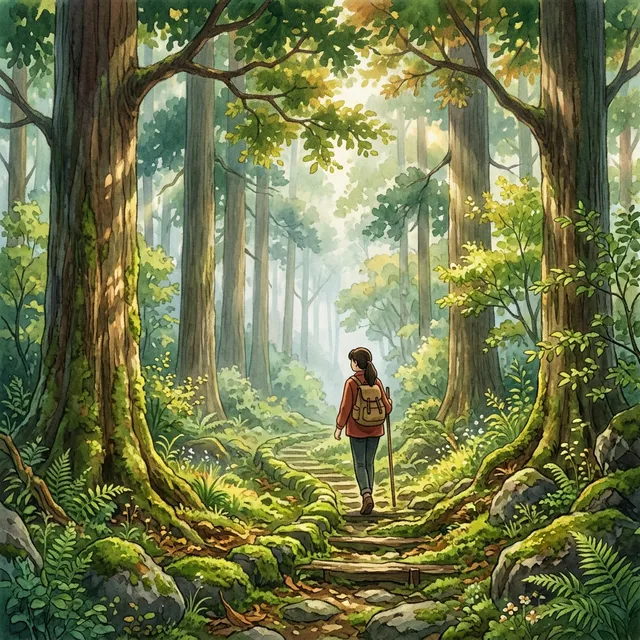
The Japanese practice of shinrin-yoku—literally "forest bathing"—entered the Western wellness vocabulary around 2017 with the quiet authority of a practice that sounds too simple to be effective and turns out to be backed by more rigorous scientific evidence than most pharmaceutical interventions for stress. The practice is exactly what its name describes: immersing yourself in a forest environment, engaging all five senses, and moving slowly and deliberately through the trees with no destination, no fitness objective, and no agenda beyond the act of being present in a natural environment. It is not hiking (which implies physical exertion and a destination). It is not nature photography (which implies a creative objective). It is not meditation in a forest (which implies a structured mental practice). It is simply being in a forest, deliberately and attentively, for an extended period.
The practice originated in Japan in 1982, when the Japanese Ministry of Agriculture, Forestry, and Fisheries coined the term shinrin-yoku as part of a national health initiative encouraging citizens to spend time in the country's extensive forest reserves. The scientific research that has since validated the practice's health benefits has been conducted primarily by Japanese researchers—Qing Li of Nippon Medical School, Yoshifumi Miyazaki of Chiba University, and their colleagues—and has accumulated into a body of evidence that is unusually robust for a wellness practice: randomised controlled trials, physiological measurements (cortisol levels, blood pressure, heart rate variability, natural killer cell activity), and psychological assessments, published in peer-reviewed journals over three decades.
What the Science Actually Shows

Stress Reduction (Definitive Evidence): The most robust finding in the shinrin-yoku research literature is the reduction of cortisol—the primary stress hormone—following forest exposure. A controlled study by Park et al. (2010), comparing subjects who walked for 15 minutes in a forest with subjects who walked for 15 minutes in an urban environment, found that the forest walkers showed significantly lower cortisol levels, lower blood pressure, lower heart rate, and higher heart rate variability (an indicator of parasympathetic nervous system activation, associated with relaxation and recovery) compared to the urban walkers. These physiological differences were measurable within 15 minutes and persisted for hours after leaving the forest environment. The effect has been replicated across dozens of studies, in multiple countries, and with diverse populations—it is among the most consistently demonstrated health effects of any environmental intervention.
Immune Function Enhancement (Strong Evidence): Qing Li's research demonstrated that spending three days and two nights in a forest environment significantly increases the count and activity of natural killer (NK) cells—a type of white blood cell that plays a critical role in immune surveillance and cancer defence. The NK cell increase persisted for up to 30 days after the forest visit. Li attributed this effect partly to phytoncides—volatile organic compounds emitted by trees (including α-pinene, β-pinene, and d-limonene) that are inhaled during forest exposure and appear to directly stimulate NK cell activity. This finding has been replicated in controlled laboratory studies where subjects exposed to phytoncide-infused air showed similar NK cell increases—suggesting that the immune benefit is attributable specifically to forest-emitted chemicals, not merely to the general relaxation of being outdoors.
Mood and Mental Health (Moderate to Strong Evidence): Forest bathing reduces scores on standardised measures of anxiety, depression, anger, fatigue, and confusion (using the Profile of Mood States scale) compared to urban environment exposure. The effect sizes are moderate—comparable to light exercise for anxiety reduction, and smaller than medication for clinical depression—but they are consistent across studies and populations. The mental health benefits appear to operate through multiple mechanisms: the physiological stress reduction described above, the attentional restoration provided by natural environments (natural stimuli engage "soft fascination"—effortless, non-demanding attention that allows the directed-attention mechanisms used in cognitive work to recover), and the emotional regulation that follows from reduced physiological arousal.
How to Practice Forest Bathing (It's Simpler Than You Think)
Forest bathing does not require instruction, equipment, or a guide—though guided sessions are available and can enhance the experience for beginners who feel self-conscious about walking slowly and aimlessly through a forest. The basic practice:
Find a forest. Not a park (too manicured, too many people), not a garden (too small, too managed), but a forest—a space where trees dominate the environment, where the canopy provides shade and creates a distinct microclimate, and where the visual, auditory, and olfactory environment is distinctly different from the urban or suburban surroundings. In Indian cities, suitable locations include: national parks and wildlife sanctuaries with walking trails (Sanjay Gandhi National Park in Mumbai, Cubbon Park's forested sections in Bangalore, the Ridge in Delhi), sacred groves (found across Western Ghats communities), plantation areas (tea and coffee plantations in South India and Northeast India), and any densely wooded area within accessible distance.
Walk slowly. The pace of forest bathing is approximately one-quarter of your normal walking speed. You are not covering distance; you are occupying a space. A 2-hour forest bathing session might cover only 1-2 kilometres—a distance that would take 15-20 minutes at normal walking pace. The slowness is not an aesthetic choice; it is functional. At normal walking speed, your attention is focused on navigation and locomotion. At forest bathing speed, your attention is free to engage with the sensory environment: the texture of tree bark, the quality of light filtering through the canopy, the sound of leaves in wind, the smell of soil and decomposing plant matter, the temperature difference between shaded and sun-exposed patches.
Engage the senses deliberately. The structured practice involves cycling through each sense: spend five minutes attending only to what you can see (the play of light, the colour gradations of green, the movement of branches). Spend five minutes attending to sound (wind, birdsong, water, the crunch of your own footsteps). Spend five minutes attending to smell (the earthy smell of humus, the resinous smell of pine, the sweet smell of flowers). Touch a tree trunk. Feel the texture of a leaf. Notice the temperature of the air on your skin. This deliberate sensory engagement is what distinguishes forest bathing from merely walking in a forest—it produces the attentional shift from internal rumination to external sensation that is the core mechanism of the practice's psychological benefits.
Forest Bathing in the Indian Context
India's relationship with forests is rich with cultural and spiritual practices that predate shinrin-yoku by millennia. The concept of vanavaasa (forest dwelling) in Hindu tradition, the grove-based meditation practices of Buddhist and Jain monasticism, and the sacred grove traditions maintained by tribal communities across the Western Ghats, Northeast India, and central Indian forests all embody a recognition—intuitive and experiential rather than scientific—that forest environments are conducive to psychological and spiritual health. Forest bathing is, in the Indian context, not an imported Japanese practice but a reconnection with indigenous environmental relationships that urbanisation has disrupted.
The practical opportunity for forest bathing in India is substantial: India contains approximately 80 million hectares of forest cover (21.7% of the country's total area), including some of the world's most biodiverse tropical and subtropical forests. The Western Ghats, the Eastern Himalayas, the forests of Northeast India, and the central Indian highlands provide forest environments that are richer in sensory stimulation—more species of trees, more variety of birdsong, more diversity of scents and textures—than the temperate forests where most shinrin-yoku research has been conducted.
Frequently Asked Questions (FAQs)
How long does a forest bathing session need to be?
The research shows measurable physiological benefits (reduced cortisol, reduced blood pressure, increased heart rate variability) from sessions as short as 15-20 minutes. However, the full range of benefits—including the immune system enhancement and the deeper psychological effects (attentional restoration, mood improvement, creative insight)—appear to require longer exposure: 2-4 hours for a single session produces effects that persist for days to weeks. The practical recommendation is: aim for 2 hours if you can; benefit from whatever time you actually have. A 30-minute forest walk during lunch is less optimal than a 3-hour weekend immersion, but it is measurably better than no forest exposure at all.
Can I get the same benefits from a park or garden?
Partially. The stress-reduction and mood-improvement effects of nature exposure occur in parks, gardens, and other green spaces—though the effects are typically smaller in magnitude than in forest environments, likely because parks have less canopy cover (reducing phytoncide exposure), more human presence (reducing the sense of solitude that contributes to mental restoration), and less sensory complexity (fewer species, less auditory diversity, less olfactory richness). If a forest is not accessible, a park or garden provides genuine benefits—the research supports nature exposure of any kind over purely urban environments. But if you have the option to choose between a manicured park and an actual forest, the forest will produce stronger effects.
Is forest bathing just a fancy name for walking in the woods?
It is and it isn't. The physical activity is the same (walking, slowly, in a forest), but the intentional, sensory-focused attention distinguishes forest bathing from casual forest walking in the same way that mindful meditation distinguishes intentional breathing practice from merely breathing. The research shows benefits from both casual forest walking and structured forest bathing, but the structured practice—with deliberate sensory engagement, slow pace, and extended duration—produces larger and more consistent effects. If calling it "forest bathing" helps you take it seriously and practice it deliberately, the name serves its purpose.



Comments (0)
Be the first to share your thoughts on this article.