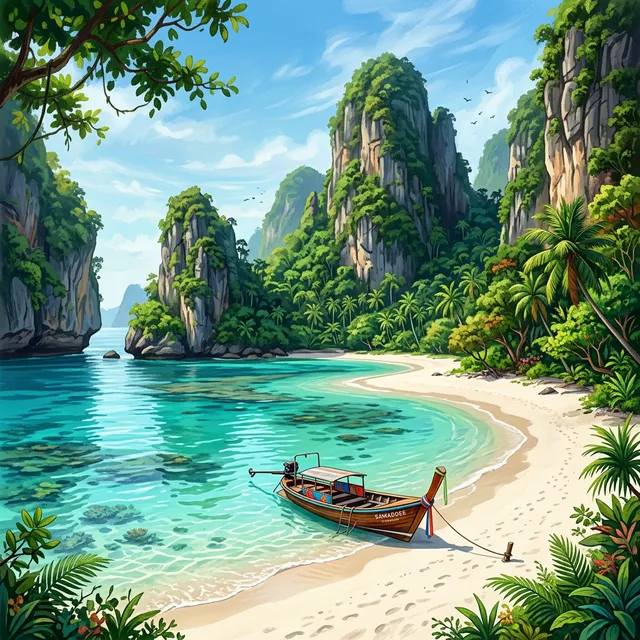
Southeast Asia maintains a seemingly inexhaustible supply of coastline that has not yet been discovered by the tour operators, the resort developers, and the Instagram influencers whose combined attention transforms a pristine beach from a place of solitude into a destination that requires advance booking, inflated pricing, and the capacity to ignore forty other tourists attempting to photograph the same sunset from the same angle. The beaches that remain hidden do so for specific, predictable reasons: they are difficult to reach (requiring boats, unpaved roads, or multiple transport connections), they lack the infrastructure that mass tourism requires (no large hotels, limited restaurant options, unreliable Wi-Fi), or they are located in regions that most tourists skip due to habit, ignorance, or the gravitational pull of established destinations.
These barriers are, from the perspective of someone genuinely seeking peace and natural beauty, features rather than bugs. Every difficulty of access is a filter that eliminates a percentage of potential visitors. The beach that requires a 45-minute boat ride from the nearest road has already eliminated everyone who is unwilling to endure 45 minutes on a boat. The beach with no nearby restaurant has eliminated everyone who cannot bring their own food. By the time you have navigated the transport connections, accepted the infrastructure limitations, and arrived at the shoreline, you are typically sharing the beach with a handful of other travelers who have passed through the same filters—self-selecting for the kind of quiet, respectful, low-impact visitor that these environments can sustainably accommodate.
Koh Rong Sanloem, Cambodia: Before the Resorts Arrive

Koh Rong Sanloem sits in the Gulf of Thailand off the coast of Sihanoukville, Cambodia—a city that has been comprehensively transformed by Chinese casino development into a place that most travelers now use exclusively as a transit point to reach the islands. The island's main beach, Saracen Bay, has accumulated enough bungalow operations and beach bars to qualify as "developed," but the island's southern and eastern coasts remain extraordinarily quiet. Lazy Beach—ironically named, given the effort required to reach it (a 30-minute hike through jungle from Saracen Bay, or a separate boat drop-off from the mainland)—is a crescent of white sand facing open ocean, backed by untouched forest, with a single low-key accommodation operation that runs on solar power and generator backup.
The snorkelling along Koh Rong Sanloem's southern shore is among the best in Cambodia—coral gardens in 2-5 metres of water, populated by parrotfish, clownfish, pufferfish, and occasional reef sharks, visible in water so clear that you can assess the snorkelling conditions from the beach before entering. The island's bioluminescent plankton—visible on dark, moonless nights when disturbed water glows electric blue—is the kind of natural phenomenon that feels hallucinatory until you see it: you wade into warm, dark water, sweep your arm through the surface, and a trail of blue light follows your movement like a visual echo. The experience is difficult to photograph (cameras struggle with the light levels) and impossible to forget.
The practical reality: getting there requires a ferry from Sihanoukville (1-2 hours, bookable through Buva Sea or Speed Ferry Cambodia), accommodation should be booked in advance during high season (November-April), and the island has no ATMs—bring sufficient cash in US dollars or Cambodian riel. Expect to pay $15-40/night for a bungalow depending on season and amenities.
Siargao's Outer Islands, Philippines
Siargao—the teardrop-shaped island in the Philippines' Mindanao region—has already been "discovered" in the Instagram sense: Cloud 9 is one of the world's most famous surf breaks, General Luna has a developed tourist infrastructure, and the island's Instagram profile now includes millions of posts. But Siargao's surrounding islands—Bucas Grande, Daku, Guyam, and the remote beaches of eastern Siargao accessible only by motorbike and boat—remain genuinely uncrowded.
Bucas Grande Island, a 2-hour boat ride from Siargao, contains the Sohoton Cove National Park—a system of lagoons, caves, and limestone formations accessible only by kayak or small boat through narrow passages that open into emerald-green enclosed lagoons. The jellyfish sanctuary—a non-stinging jellyfish lake similar to Palau's famous Jellyfish Lake but at a fraction of the tourist volume—allows you to swim among thousands of harmless jellyfish in an enclosed marine lake. The experience is surreal. The visitor count on most days is under twenty people.
The beach at Pacifico, on Siargao's northern coast, is a 90-minute motorbike ride from General Luna on progressively deteriorating roads. The beach itself is a long, wide crescent of fine sand facing consistent surf breaks, backed by coconut palms and a small barangay (village) with two or three basic accommodation options. There is no nightlife, no restaurant scene, and no reliable Wi-Fi. There is a beach that would be world-famous if it were easier to reach, and the particular quality of solitude that exists only in places where the infrastructure has not yet accommodated mass arrival.
Con Dao, Vietnam
Con Dao—an archipelago of 16 islands in the South China Sea, 230 kilometres south of Ho Chi Minh City—is Vietnam's most beautiful coastal destination and one of the least visited by international tourists. The reason for its obscurity is historical: Con Dao was the site of a French colonial and later South Vietnamese political prison, and its association with suffering and punishment has created a cultural gravity that has, until recently, suppressed its development as a resort destination. The Vietnamese visit Con Dao as a pilgrimage—to honour the political prisoners who suffered and died there—and the sombre historical context has, paradoxically, preserved the islands' natural environment by discouraging the kind of reckless resort development that has degraded more commercially oriented Vietnamese beaches.
The snorkelling and diving around Con Dao is exceptional—the islands were designated a national park in 1993, and the marine environment has been actively protected since. Sea turtle nesting (green and hawksbill turtles lay eggs on Con Dao's beaches from June to September) is monitored by conservation programs that allow limited visitor observation. The beaches—particularly Dam Trau, Bai Dat Doc, and the beaches of Bay Canh Island—are postcard-perfect crescents of white sand and turquoise water backed by tropical forest, and on weekdays outside Vietnamese holiday periods, you may share them with fewer than ten other people.
Reaching These Beaches: Practical Logistics
The logistical challenge of reaching hidden beaches is the price of admission for solitude. In each case, the journey is part of the experience—not in the Instagram-inspirational "the journey is the destination" sense, but in the practical sense that the journey itself filters your fellow visitors and sets the expectation for the kind of experience you will have. Pack accordingly: a dry bag for electronics during boat transfers, reef-safe sunscreen, sufficient cash, basic first aid, and the emotional preparation for accommodation that is functional but not luxurious. The trade is direct and non-negotiable: comfort and convenience are inversely proportional to solitude and natural beauty. If you want both simultaneously, the beaches you seek do not exist in the forms you want them.
Frequently Asked Questions (FAQs)
When is the best time to visit Southeast Asian beaches?
The optimal season varies by coast and country. Thailand's Andaman coast (Phuket, Krabi, Koh Lipe): November-April (dry season). Thailand's Gulf coast (Koh Samui, Koh Phangan): January-August. Cambodia: November-April. Philippines: November-May for most islands (Siargao has surfable waves year-round). Vietnam's southern islands (Con Dao, Phu Quoc): November-March. Indonesia (Bali, Lombok): April-October (dry season). The shoulder months (just before and after peak season) typically offer the best combination of good weather and reduced crowds.
Are hidden beaches safe for solo travelers?
The primary safety considerations are marine (rip currents, jellyfish, coral cuts) rather than criminal. Most remote beaches lack lifeguards, so swimming competence and ocean awareness are essential. Check locally for current conditions before entering the water. Bring a basic first aid kit and know the location of the nearest medical facility. Regarding personal safety, Southeast Asian beach communities are generally welcoming and safe—crime rates against tourists in remote beach areas are typically lower than in cities. The main risks are logistical (missed boats, accommodation unavailability, transport breakdowns) rather than personal safety.
How do I find hidden beaches that aren't in any guidebook?
Talk to locals—specifically, to boat operators, fishermen, and guesthouse owners who know their coastline intimately. Ask: "Where do local people go swimming on their day off?" The answer almost always identifies beaches that guidebooks overlook because they lack the tourist infrastructure that guidebook criteria require. Google Maps satellite view is another excellent tool—scan the coastline for beaches that appear pristine (no visible structures, no roads leading to them) and ask locally about access. Offline forums and communities like Thorn Tree (Lonely Planet), Reddit's r/solotravel, and specialised Facebook groups for specific countries often have recent, first-hand reports of lesser-known beaches from travelers who have recently visited.
Environmental Responsibility at Hidden Beaches: The privilege of accessing undeveloped beaches carries an obligation that mass tourism destinations have already failed to meet: leave no trace. Pack out all waste (including food waste—banana peels and fruit rinds are not native to beach ecosystems and take months to decompose). Use reef-safe sunscreen (sunscreens containing oxybenzone and octinoxate are toxic to coral at concentrations as low as one drop per six Olympic swimming pools). Do not collect shells, coral, or marine specimens—even dead shells serve as substrate for algae and shelter for hermit crabs. The beauty of hidden beaches is a direct consequence of their low visitor numbers; every visitor who leaves waste or damages the environment contributes to the degradation that transforms hidden beaches into the overcrowded, polluted versions they were meant to escape.

Comments (0)
Be the first to share your thoughts on this article.