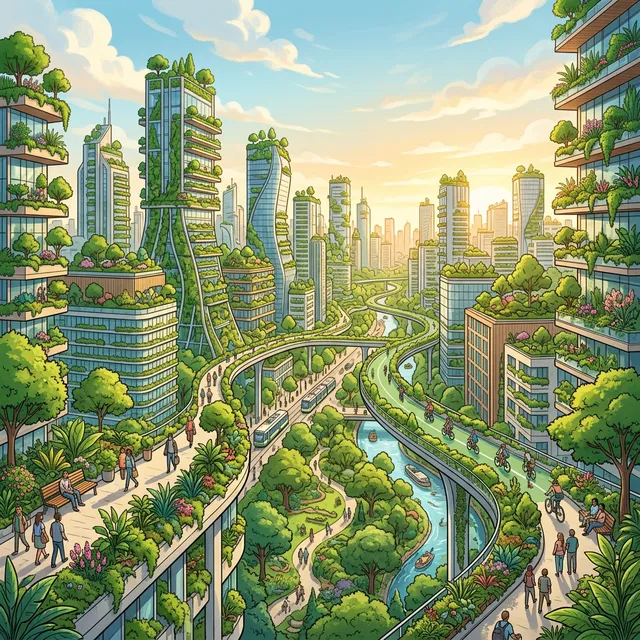
The idea that cities and forests are mutually exclusive—that urbanisation necessarily displaces nature and that restoring nature requires de-urbanising—is one of the most persistent and most damaging assumptions in environmental thinking. It persists because it feels intuitively obvious: cities are made of concrete and steel; forests are made of trees and soil; therefore cities cannot be forests. But this intuition fails to account for the extraordinary volume of space within cities that is not covered by buildings or roads—the parks, vacant lots, roadside verges, railway embankments, riverbanks, residential gardens, institutional campuses, and rooftops that collectively constitute a substantial proportion of urban land area. In most cities, 30-50% of the total land area is "green" in the sense of being unpaved and potentially available for tree cover. The urban forest movement asks a simple, radical question: what if we actually forested it?
The concept of urban forestry is not new—urban parks have existed for centuries, and street tree planting has been a feature of city planning since the Roman era. What is new is the ambition: cities are now setting tree canopy targets (Singapore: 50% canopy cover; Melbourne: 40% by 2040; New York City: 30% canopy cover), implementing mandatory tree retention and replacement policies in development regulations, creating urban forests on previously built land (the Miyawaki method of dense native planting, which can establish a self-sustaining forest on a plot as small as 100 square metres), and measuring the economic value of urban trees so that their preservation can compete with development pressure on cost-benefit terms.
The Miyawaki Method: Forests in Years, Not Decades

The most exciting development in urban forestry is the Miyawaki method—a technique developed by Japanese botanist Akira Miyawaki that produces dense, biodiverse, native forests in 20-30 years rather than the 100-200 years required for natural succession. The method involves: surveying the native plant species that would naturally occur at the planting site (the "potential natural vegetation"), preparing the soil with organic amendments to create optimal growing conditions, planting native species at extreme density (3-5 saplings per square metre, compared to conventional forestry planting of 1 sapling per 3-5 square metres), mixing species randomly to replicate natural forest complexity, and then maintaining the plantation for 2-3 years (weeding, watering) before the forest becomes self-sustaining and requires no further human intervention.
The results are genuine and measurable. A Miyawaki forest grows approximately 10 times faster than a conventional plantation, reaches canopy closure in 3-5 years, achieves the biodiversity of a natural forest within 20-30 years, and—once established—is entirely self-sustaining: no watering, no fertilising, no maintenance. The method has been successfully applied in over 3,000 locations worldwide, including several Indian cities: Bengaluru's Cubbon Park area, Chennai's industrial zones, and various community-led initiatives across Maharashtra and Kerala.
The Indian application of the Miyawaki method is particularly promising because India's tropical and subtropical climate produces faster tree growth than temperate regions, the native species palette is extraordinarily diverse (India contains approximately 7,000 native tree species), and the need is urgent (India's urban tree cover has been declining steadily as development pressure overwhelms municipal tree protection). Organisations like Afforestt (founded by Shubhendu Sharma, who worked directly with Akira Miyawaki) and the Green Yatra Foundation have planted hundreds of Miyawaki forests across Indian cities, demonstrating that the method works in Indian soils, Indian climates, and Indian urban contexts.
The Economics of Urban Trees
Urban trees are not merely aesthetic amenities—they are economic infrastructure whose benefits can be quantified in monetary terms. A study by the US Forest Service found that each urban tree provides an average annual benefit of $120-150 (approximately ₹10,000-12,500) through: air pollution removal (filtering particulate matter, absorbing gaseous pollutants—valued at ₹1,500-3,000 per tree per year in Indian cities with severe air quality issues), stormwater management (absorbing rainfall, reducing runoff and flood risk—valued at ₹1,000-2,000 per tree per year), energy savings (shade reducing building cooling costs by 10-30% for buildings within the shade zone—valued at ₹2,000-5,000 per tree per year in Indian climates), property value enhancement (properties within 100 metres of mature trees are valued 5-15% higher than comparable properties without tree cover), and carbon sequestration (each mature tree absorbs 20-50 kg of CO₂ per year).
When these benefits are aggregated across an urban forest of 100,000 trees, the annual economic benefit is ₹100-125 crore—a return on investment that significantly exceeds the cost of planting and maintaining those trees. This economic framing is critical for urban forestry advocacy because it transforms trees from "nice to have" aesthetic features into quantifiable infrastructure investments that compete with roads, buildings, and utilities on cost-benefit terms. Mumbai's urban tree cover, estimated at over 2 million trees, provides ecosystem services worth hundreds of crores annually—a value that is systematically ignored in development decisions that remove trees for construction.
What You Can Do: Personal and Community Urban Forestry
Urban forestry does not require municipal government action to begin. The most impactful actions are available to individuals and community organisations: plant native trees on private land (a residential compound, an institutional campus, a commercial property), advocate for tree protection in local development decisions (most Indian municipalities have tree protection ordinances that require public notice and permission for tree felling—attend the hearings and object to unnecessary removals), support community Miyawaki forest projects (many require as little as 100 square metres of unused land), and maintain the trees that already exist (watering newly planted street trees, reporting damaged trees to municipal authorities, preventing illegal felling).
For apartment dwellers with no ground-level access, terrace and balcony gardening with native species (including fruiting trees in large containers—mango, guava, lemon, curry leaf trees can be grown in pots on sunny terraces) contributes to urban greenery and provides habitat for birds and insects. The individual contribution is small; the collective effect of thousands of individuals making pro-tree decisions in their personal and professional spaces is the foundation on which urban forest policy is built.
Frequently Asked Questions (FAQs)
How much space do I need for a Miyawaki forest?
A Miyawaki forest can be established on as little as 100 square metres—roughly the size of a small residential garden or an unused corner of an institutional campus. The minimum size for ecological self-sustainability (where the forest can maintain itself without human intervention after the initial 2-3 year establishment period) is approximately 300-500 square metres. However, even a 100-square-metre planting provides measurable air quality, temperature reduction, and biodiversity benefits to its immediate surroundings. The cost of establishing a Miyawaki forest in India is approximately ₹500-1,500 per square metre (including soil preparation, saplings, and 2-3 years of maintenance), or ₹50,000-1,50,000 for a 100-square-metre plot—comparable to a modest home improvement project.
Which native trees are best for Indian urban environments?
The answer varies by region and climate zone, but generally excellent urban species include: Neem (Azadirachta indica)—drought-tolerant, pest-resistant, air-purifying, and culturally significant across India. Peepal (Ficus religiosa)—exceptional air purifier (produces oxygen 24 hours through a modified photosynthesis pathway), supports enormous insect biodiversity, and provides dense shade. Banyan (Ficus benghalensis)—India's national tree, creating massive canopy cover and supporting extensive wildlife communities. Jamun (Syzygium cumini)—native, fruiting, provides dense shade and food for birds. Albizia (Albizia lebbeck)—nitrogen-fixing, fast-growing, excellent shade tree. The critical principle is to choose native species rather than ornamental exotics (like Gulmohar or Royal Palm, which are beautiful but support minimal native biodiversity).
Are urban forests actually effective at improving air quality?
Yes, with important caveats. Urban tree canopy removes particulate matter (PM2.5 and PM10) by intercepting particles on leaf surfaces and absorbs gaseous pollutants (NO₂, SO₂, O₃) through leaf stomata. A dense urban tree canopy can reduce street-level PM2.5 concentrations by 10-25% within and downwind of the canopy zone. However, trees alone cannot solve India's air quality crisis—the pollution sources (vehicle emissions, industrial emissions, crop burning, construction dust) produce pollutant volumes that exceed the absorptive capacity of any realistic urban forest. Trees are a complementary measure that reduces exposure and improves local air quality, not a substitute for emission reduction at source. In combination with emission controls, urban forests are one of the most cost-effective air quality interventions available.
Getting Involved: Starting an Urban Forest Initiative
If you are inspired to take action, the most impactful steps are surprisingly accessible. First, identify a candidate site: an unused plot in your residential society, an abandoned lot owned by a government agency, a section of your institutional campus that is currently maintained as low-value lawn. Second, build a coalition: approach your Resident Welfare Association, your local municipal councillor, or the institutional administration with a proposal that includes: the site dimensions, the estimated cost, the ecological and economic benefits, and a maintenance plan. Third, partner with an established organisation: Afforestt, Green Yatra Foundation, SayTrees, and numerous local environmental groups have the technical expertise to design and implement Miyawaki forests—they can provide species selection, soil preparation guidance, planting supervision, and maintenance training. Fourth, plant: a community planting event engages neighbours, builds stewardship, and provides the social accountability that ensures the forest receives the 2-3 years of maintenance it needs to become self-sustaining. The entire process—from idea to planted forest—can be completed in 3-6 months with committed leadership and modest funding.

Comments (0)
Be the first to share your thoughts on this article.