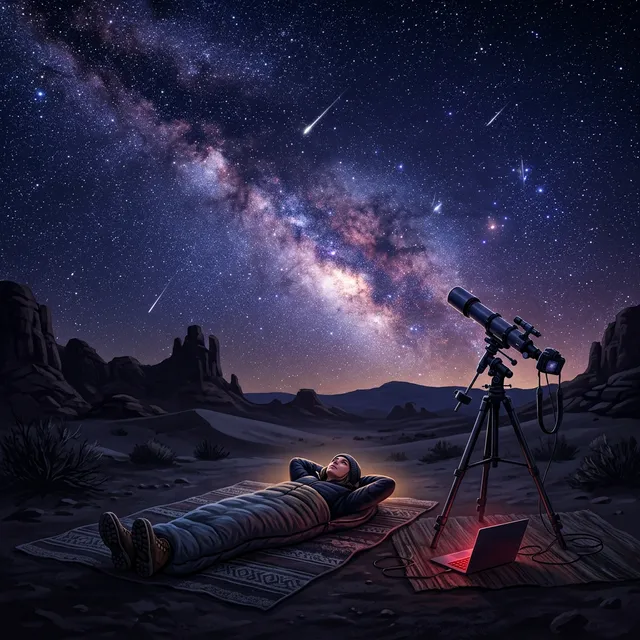
I saw the Milky Way for the first time at the age of twenty-eight. This fact is not remarkable—it is statistically normal. An estimated 80% of the world's population lives under light-polluted skies, and approximately one-third of humanity cannot see the Milky Way at all from their place of residence. For urban Indians—and 35% of India's 1.4 billion people are now urban—the night sky contains, on a good night, perhaps 20-50 visible stars, compared to the approximately 4,500 that are visible to the naked eye under truly dark skies. The remaining 4,450 stars are not absent; they are hidden behind a dome of scattered artificial light—the streetlights, building lights, advertising displays, vehicle headlights, and industrial lighting whose cumulative glow creates an atmospheric brightness that reduces the sky's contrast to a flat, amber-grey uniformity.
Dark sky tourism—traveling to locations where the night sky is sufficiently free from artificial light to reveal the full depth and complexity of the cosmos—is one of the fastest-growing niche travel categories globally. The appeal is both aesthetic (the Milky Way, visible as a luminous band spanning the entire sky, is arguably the most beautiful natural phenomenon visible from Earth) and existential (the experience of seeing thousands of stars, the occasional satellite, and the faint glow of distant galaxies produces a perspective shift that no photograph or planetarium can replicate—a visceral, felt awareness of cosmic scale and your infinitesimal place within it).
What Makes a Sky "Dark": Understanding the Bortle Scale

Sky darkness is measured on the Bortle Dark-Sky Scale—a nine-level classification system where 1 represents an excellent dark-sky site (the Milky Way casts visible shadows, zodiacal light extends to the horizon, airglow is visible) and 9 represents an inner-city sky (only the Moon, planets, and a handful of the brightest stars are visible). Most urban areas rate 7-9. Most suburban areas rate 5-6. To see the Milky Way clearly, you need a Bortle 3-4 site or darker. To see the night sky in its full glory—the Milky Way as a textured, three-dimensional structure with visible dust lanes, the Andromeda Galaxy as a smudge visible to the naked eye, meteors flaring across a sky dense with stars—you need a Bortle 1-2 site, which requires traveling to locations that are at least 100-200 kilometres from any significant city and have no substantial local light sources.
The International Dark-Sky Association (IDA) certifies locations that have committed to reducing light pollution and preserving dark-sky conditions. These certified Dark Sky Parks, Reserves, and Communities represent the gold standard for dark-sky tourism—locations where the local government and community have implemented outdoor lighting ordinances, shielded lighting requirements, and public education programmes to protect the night sky as a shared natural resource.
India's Best Dark Sky Locations
Hanle, Ladakh: The Indian Astronomical Observatory at Hanle (altitude: 4,500 metres) is located at one of the darkest sites in the world—its remoteness (200 km from the nearest significant town, Leh), altitude (above most atmospheric moisture and particulate matter), and arid climate (clear skies 250+ nights per year) produce a sky darkness that rivals the best astronomical observatories on Earth. The village of Hanle has been developed as India's first dark-sky sanctuary, with local lighting regulations and astro-tourism infrastructure. Under Hanle's skies, the Milky Way appears not as a faint band but as a three-dimensional structure—a river of light with clearly visible dark dust lanes, bright star clouds, and the central galactic bulge glowing with the concentrated light of billions of stars. The Magellanic Clouds—satellite galaxies visible only from extremely dark sites—are visible from Hanle on clear nights.
Spiti Valley, Himachal Pradesh: The entire Spiti Valley, at altitudes of 3,800-4,500 metres, offers excellent dark-sky conditions. The Key Monastery, Kibber, and Langza provide dramatic foreground subjects for astrophotography—ancient Buddhist monasteries and high-altitude villages framed against a sky dense with stars. The combination of cultural heritage, dramatic landscape, and dark skies makes Spiti one of the world's best destinations for the particular intersection of travel photography and astronomy that dark-sky tourism represents.
Rann of Kutch, Gujarat: The vast salt desert of the Rann offers a unique dark-sky experience: the flat, featureless white landscape provides a 360-degree unobstructed horizon, and the remoteness from major cities produces Bortle 2-3 conditions during the dry season (October-March). The reflection of starlight on the salt surface creates an ethereal effect—you stand on a dimly luminous white plain under a sky dense with stars, with no topographic feature or human structure to provide scale, and the distinction between ground and sky dissolves. It is the closest terrestrial approximation of floating in space that does not require leaving the atmosphere.
Pangong Lake, Ladakh: The dark skies above Pangong Lake—a 134-kilometre-long lake straddling the India-China border at an altitude of 4,350 metres—provide what is arguably the most photographically spectacular dark-sky setting in India. The lake's surface, when calm, reflects the star field with sufficient clarity that photographs taken at Pangong show a doubling of the sky—stars above and their reflections below—creating images that are simultaneously scientifically impossible (the reflected stars are optically dimmed and aberrated relative to the direct stars) and aesthetically extraordinary.
Astrophotography: Capturing What You See
Photographing dark skies requires specific equipment and technique. The essential kit: a camera capable of manual exposure (DSLR or mirrorless), a wide-angle lens (14-24mm equivalent, with the widest available aperture—f/2.8 or wider is ideal), a sturdy tripod, and a remote shutter release or intervalometer. The basic technique: set the lens to manual focus at infinity, open the aperture to maximum (f/2.8 or wider), set the ISO to 3200-6400, and calculate the maximum exposure time using the "500 rule" (divide 500 by the focal length of your lens to get the maximum exposure time in seconds before stars begin to trail due to Earth's rotation—for a 14mm lens: 500÷14 = 36 seconds maximum). This simple formula produces a correctly exposed image of the Milky Way on the first attempt in most cases.
The emotional experience of astrophotography—standing alone in darkness, surrounded by silence, watching the camera's LCD confirm that it has captured a scene more beautiful than what your eyes alone can see (cameras accumulate light over their exposure time, revealing faint structures invisible to the eye)—is one of the most rewarding experiences available in photography. The first time you see the Milky Way appear on your camera's screen, with colours and detail you did not see with your naked eye, is a moment of genuine wonder that survives repetition.
Frequently Asked Questions (FAQs)
When is the best time for dark-sky viewing in India?
The optimal period for Milky Way viewing in India is March-October, when the galactic centre (the brightest and most photogenic section of the Milky Way) is above the horizon during nighttime hours. Within this period, the best nights are those around the new moon (when moonlight does not wash out the fainter stars and nebulae). Clear, dry conditions are essential—monsoon months (July-September) are generally poor for stargazing across India except in rain-shadow regions like Ladakh and Spiti. For Hanle and Ladakh: May-October (road access is seasonal; the Manali-Leh and Srinagar-Leh highways close in winter). For the Rann of Kutch: October-March (dry season when the salt flat is accessible). For Spiti: June-October.
Do I need a telescope to enjoy dark-sky tourism?
No. The naked-eye experience of a truly dark sky is more transformative than any telescopic view for first-time visitors. A telescope reveals extraordinary detail of individual objects (the rings of Saturn, the moons of Jupiter, the Orion Nebula, galaxies, star clusters) but narrows your field of view to a tiny portion of the sky. The emotional impact of dark-sky tourism comes from the panoramic naked-eye view: the full Milky Way spanning the entire sky, thousands of stars visible in every direction, occasional meteors flaring across your peripheral vision. Binoculars (10x50 or similar—widely available for ₹3,000-8,000) are the ideal compromise: they show significantly more than naked eyes (star clusters resolve into individual stars, the Andromeda Galaxy shows structure) while maintaining a wide enough field of view to preserve the panoramic experience.
Is light pollution actually harmful, or is it just an aesthetic issue?
Light pollution produces documented health, ecological, and economic harms beyond the aesthetic loss of the night sky. Health: artificial light at night disrupts circadian rhythms and suppresses melatonin production—meta-analyses associate chronic light-at-night exposure with increased rates of breast cancer, prostate cancer, obesity, and mood disorders. Ecology: artificial light disrupts migratory patterns (billions of birds die annually from light-related collisions and navigation errors), disrupts reproductive cycles (sea turtles, fireflies, and numerous insect species are directly harmed by artificial light), and disrupts predator-prey relationships (predators that hunt in darkness lose their advantage; prey species that use darkness for protection lose theirs). Economics: poorly designed outdoor lighting wastes approximately 30-50% of its energy illuminating the sky rather than the ground—globally, this represents billions of dollars in wasted electricity and the corresponding unnecessary carbon emissions. Dark-sky preservation is simultaneously an environmental, health, ecological, and economic issue.


Comments (0)
Be the first to share your thoughts on this article.